

On This Day in Lifestyles: January 28, 1958
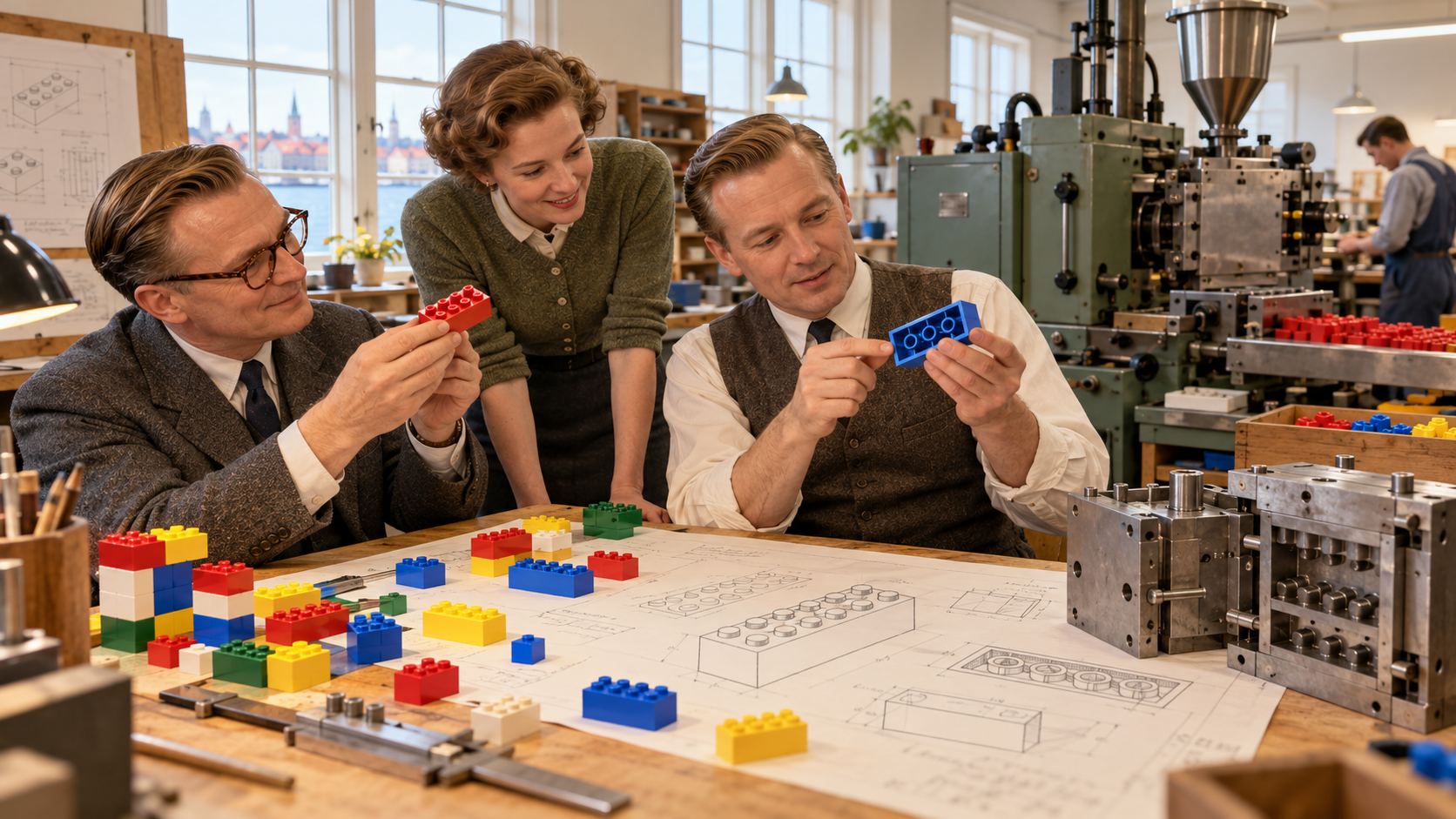
On January 28, 1958, the LEGO company filed a Danish patent application for the stud-and-tube coupling principle that made its plastic building bricks lock firmly together while remaining easy to separate. The application was submitted in Copenhagen at 1:58 in the afternoon. LEGO had sold earlier versions of plastic bricks, but the new internal tubes gave models greater “clutch power.” Children could lift, turn, and rebuild their creations without the walls collapsing, turning a simple block into the foundation of a durable system of play.
The idea grew from a family business in Billund, Denmark. Carpenter Ole Kirk Kristiansen began making wooden toys during the 1930s and chose the name LEGO from the Danish phrase “leg godt,” meaning “play well.” His son Godtfred Kirk Christiansen helped guide the company toward a unified play system rather than a collection of unrelated toys. Plastic molding allowed precise, repeatable pieces, while the 1958 design made bricks compatible in a way that encouraged expansion. A child could add new sets without abandoning the pieces already owned.
That compatibility changed the rhythm of play. A model did not have to remain what the instructions described; a house could become a spaceship, a bridge, or an invented machine. The brick offered clear constraints—regular dimensions and connection points—while leaving the story open. Parents valued a toy that could be reused, shared, and combined, and educators found opportunities to explore planning, geometry, engineering, and cooperation. Generations could even build together because bricks made decades apart continued to connect.
The LEGO system later expanded into minifigures, themed sets, robotics, movies, games, and elaborate adult collections, but its core experience still depends on the 1958 connection. The brick shows how a small design improvement can shape daily life when it supports imagination instead of prescribing a single outcome. It also raises modern questions about plastic production, durability, reuse, and responsible materials. On this day, a patent filing secured an elegant mechanical idea that helped make construction play a shared language in homes and classrooms around the world. Because the same elements can produce both realistic structures and imaginary worlds, the brick fits many ages and skill levels. A beginner can stack a wall in minutes, while experienced builders can plan gears, curves, architecture, and moving machines. The system rewards experimentation because a failed idea can be taken apart without being lost. That reversibility keeps play active, flexible, and forgiving.
Studs on top and tubes underneath created a secure connection with enough grip to hold a model together.
The same pieces could still be separated and reused, encouraging repeated building instead of a single finished object.
Standard dimensions allowed old and new bricks to work together across many sets.
That compatibility made each purchase part of a growing collection rather than an isolated play experience.
Open-ended building supports storytelling, spatial thinking, planning, engineering, and collaboration.
Long-lasting compatibility lets children, parents, and collectors create with pieces produced many years apart.
Explore more of “This Day in Lifestyles”
Discover more moments in everyday life, design, education, travel, food, fashion, and culture. Each story connects a calendar date with an event that changed how people lived.