

On This Day in News: February 1, 2003
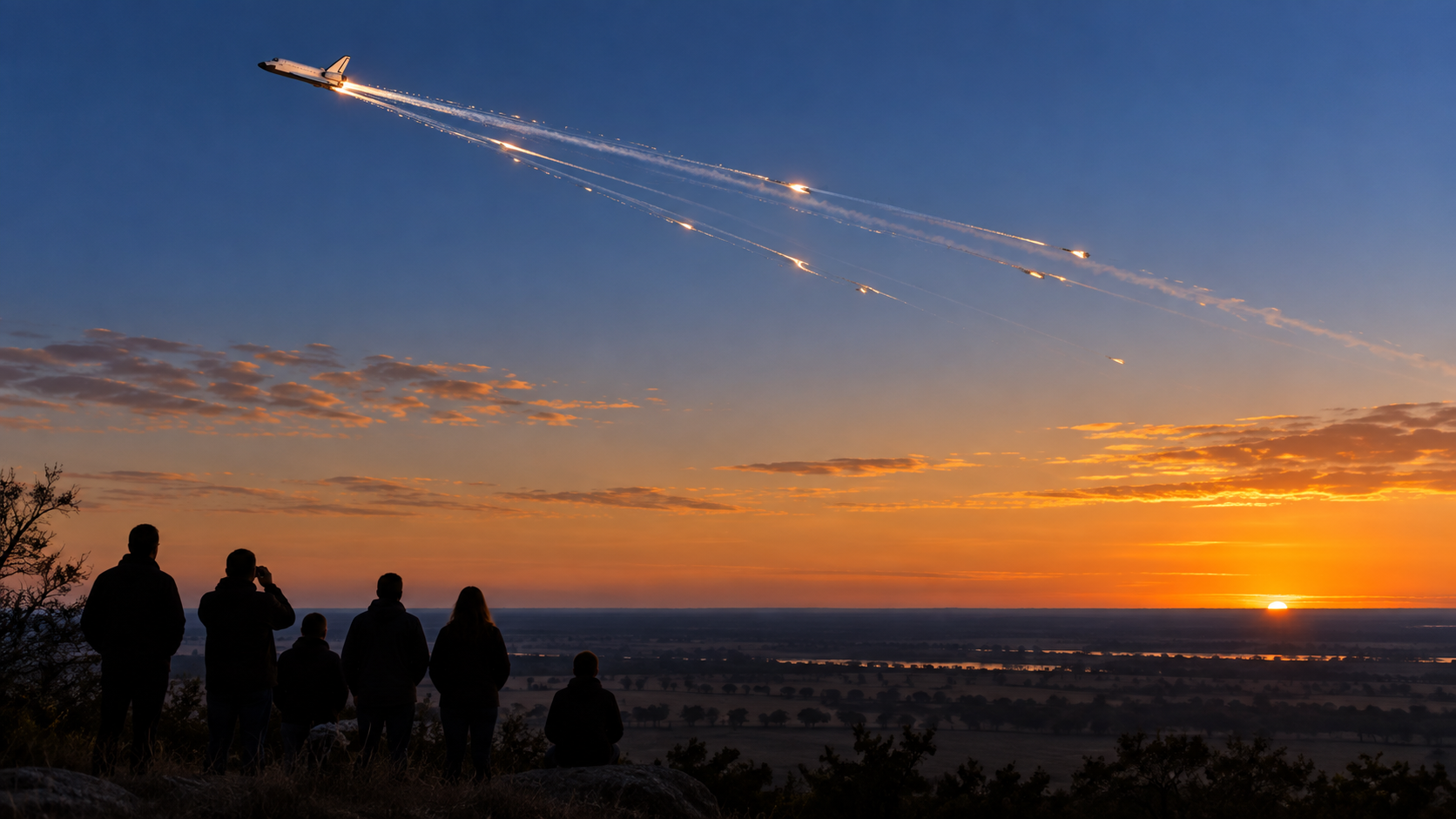
On February 1, 2003, Space Shuttle Columbia broke apart during reentry over Texas, about 16 minutes before its scheduled landing in Florida. All seven members of mission STS-107 were killed: commander Rick Husband, pilot William McCool, payload commander Michael Anderson, mission specialists Kalpana Chawla, David Brown and Laurel Clark, and Israeli payload specialist Ilan Ramon. The crew had spent nearly 16 days conducting a dedicated research mission in orbit. Families, flight controllers, and television viewers were waiting for the landing when communications and tracking data failed. Bright fragments crossed the morning sky, turning a routine homecoming into one of the defining disasters of the space-shuttle era.
The fatal damage had begun during launch on January 16. A piece of insulating foam separated from the external tank about 82 seconds after liftoff and struck the leading edge of Columbia’s left wing. The impact opened a breach in the reinforced carbon-carbon thermal protection. During the mission, engineers discussed the strike and sought additional imagery, but managers concluded that the foam did not present a safety-of-flight issue. The crew completed its experiments without knowing the wing could not withstand reentry. As Columbia descended on February 1, superheated gas entered the breach, damaged internal structures, and caused the wing and vehicle to fail under extreme aerodynamic forces.
The loss triggered an enormous response across Texas and Louisiana. Federal, state, and local teams secured a debris field stretching hundreds of miles, recovered remains, and collected shuttle components for investigation. NASA grounded the remaining fleet, while the independent Columbia Accident Investigation Board examined physical evidence, engineering records, and management decisions. Its report identified the foam strike as the direct physical cause and also found organizational causes, including flawed risk assessment, communication barriers, and the normalization of known hazards. The finding made clear that the accident could not be explained as a single broken component; technical vulnerability and institutional decision-making had reinforced each other.
Shuttle flights resumed in 2005 with new inspection methods, imagery requirements, repair planning, and procedures for providing a safe haven or rescue option when possible. Foam shedding remained a concern, and the program completed the International Space Station before the shuttle’s retirement in 2011. Columbia’s crew is commemorated in memorials, scholarships, scientific names, and NASA’s continuing remembrance ceremonies. The disaster also became a lasting case study in engineering ethics and high-risk management. Its central lesson is demanding: past success cannot turn a recurring anomaly into an acceptable condition, and organizations must preserve routes for unwelcome evidence to change a decision before the margin for action disappears.
STS-107 was a research flight rather than an International Space Station assembly mission. Its Spacehab module supported around-the-clock experiments in biology, materials, combustion, and Earth observation.
Columbia was NASA’s first operational shuttle orbiter and had flown since 1981. Age alone did not cause the accident; the decisive vulnerability was the launch impact on the wing’s thermal-protection leading edge.
Loss of sensor readings in the left wing preceded the breakup. Investigators later reconstructed the failure sequence by combining telemetry, recovered debris, launch imagery, and aerodynamic analysis.
A rescue during STS-107 would have required recognizing the damage early and mounting an extraordinarily difficult response. The investigation focused on why the available warning signs did not produce a more urgent effort to determine the wing’s condition.
NASA added on-orbit heat-shield inspections and improved launch cameras after the accident. The agency also changed decision processes intended to elevate engineering concerns and make risk assumptions explicit.
Columbia is remembered alongside Challenger as evidence that complex systems can fail through both hardware damage and organizational culture. The case remains widely taught in aerospace, safety, and public administration.
Explore more of "On This Day ..."
Discover more events from the same date across news, politics, technology, sports, and other fields. Each link highlights significant moments that shaped history on different fronts.