

On This Day in News: February 2, 1943
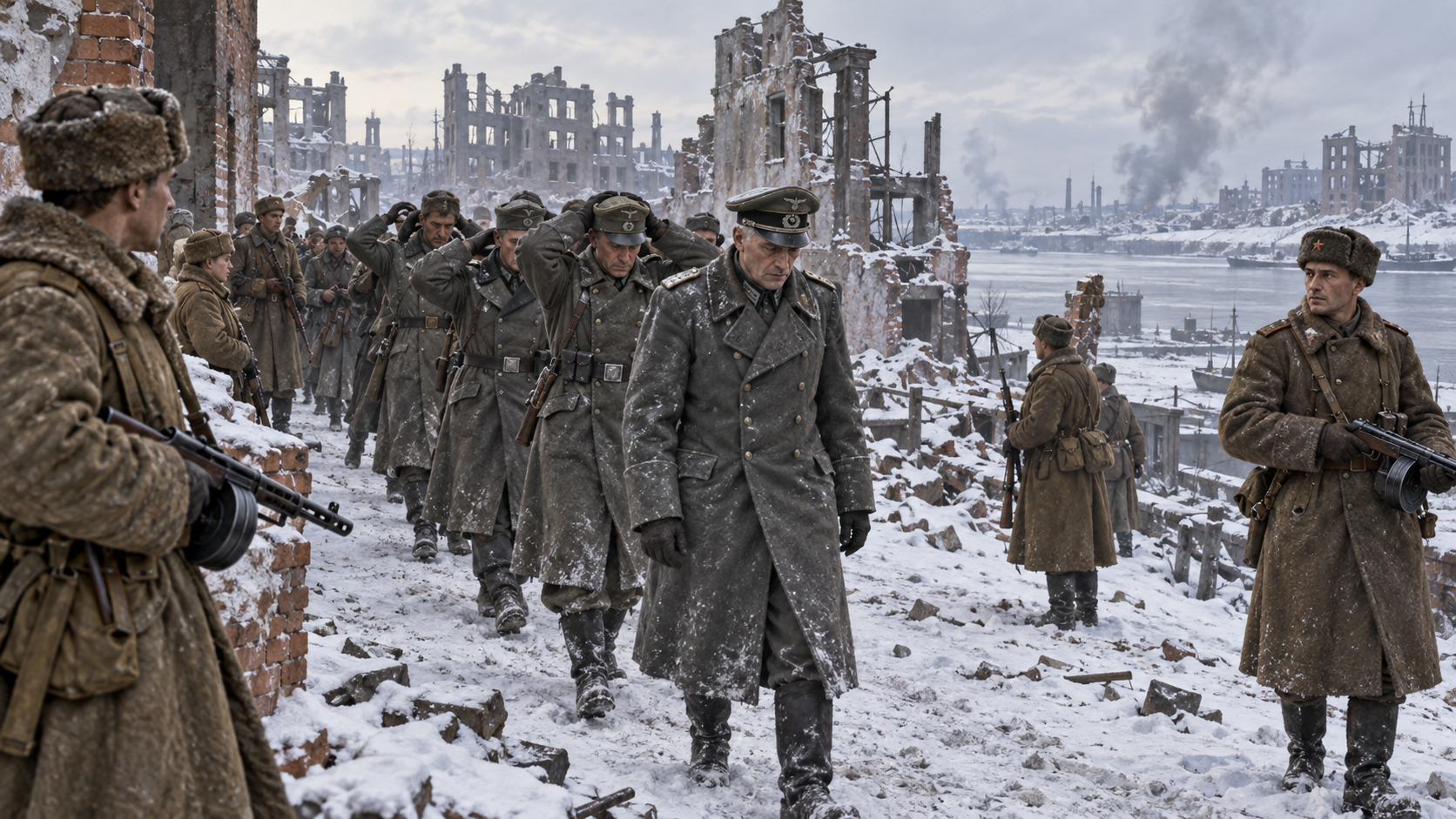
On February 2, 1943, the final organized German forces trapped in Stalingrad surrendered to the Soviet Red Army, bringing one of World War II's most destructive battles to an end. Fighting had consumed the industrial city on the Volga for more than five months. Germany's Sixth Army, commanded by Field Marshal Friedrich Paulus, had been ordered to seize the city and cut Soviet transport routes. Instead, its advance became a costly block-by-block struggle against Soviet troops who defended factories, apartment ruins, and river crossings under relentless bombardment.
The battle changed decisively in November 1942, when Soviet forces launched Operation Uranus against the weaker Romanian and other Axis units guarding the German flanks. The offensive encircled the Sixth Army and allied formations. Adolf Hitler rejected requests for a breakout, while an attempted airlift failed to deliver enough food, fuel, ammunition, or medical supplies. A German relief effort stopped short of the city. As winter deepened, starvation, disease, frostbite, and combat steadily reduced the surrounded force's ability to resist.
Paulus surrendered the southern pocket on January 31, shortly after Hitler promoted him to field marshal. Two days later, the remaining northern group under General Karl Strecker laid down its arms. Tens of thousands of exhausted Axis soldiers entered Soviet captivity; only a small portion would eventually return home. Soviet losses were also immense, and the city was largely destroyed. The victory came at a terrible human cost shared by soldiers and civilians across the region.
Stalingrad became a strategic and psychological turning point. Germany lost an entire field army, while the Soviet Union gained momentum for a series of offensives that pushed westward. The outcome weakened the aura of German invincibility and demonstrated the Red Army's growing capacity to coordinate large encirclement operations. The battle remains central to the history of the Eastern Front and to public memory in Russia, Germany, and the countries whose troops and civilians were drawn into the campaign.
Stalingrad mattered because the Volga carried supplies and the city guarded routes toward the Caucasus oil fields. Its symbolic name also gave the campaign unusual political importance.
Urban combat reduced advantages in mobility and forced both armies into close fighting over individual buildings, factories, and riverbank positions.
The February 2 surrender ended organized Axis resistance inside the encirclement and freed Soviet formations for operations elsewhere on the front.
Victory did not erase the scale of Soviet losses or the destruction of the city. Civilian suffering remained an essential part of the battle's history.
The encirclement showed how exposed flanks, weak logistics, and rigid command decisions could undo a large attacking force.
Stalingrad became a lasting warning about attritional warfare and a defining symbol of the Eastern Front's enormous human cost.
Explore more of "On This Day ..."
Discover more events from the same date across news, politics, technology, sports, and other fields. Each link highlights significant moments that shaped history on different fronts.