

On This Day in News: February 9, 1964
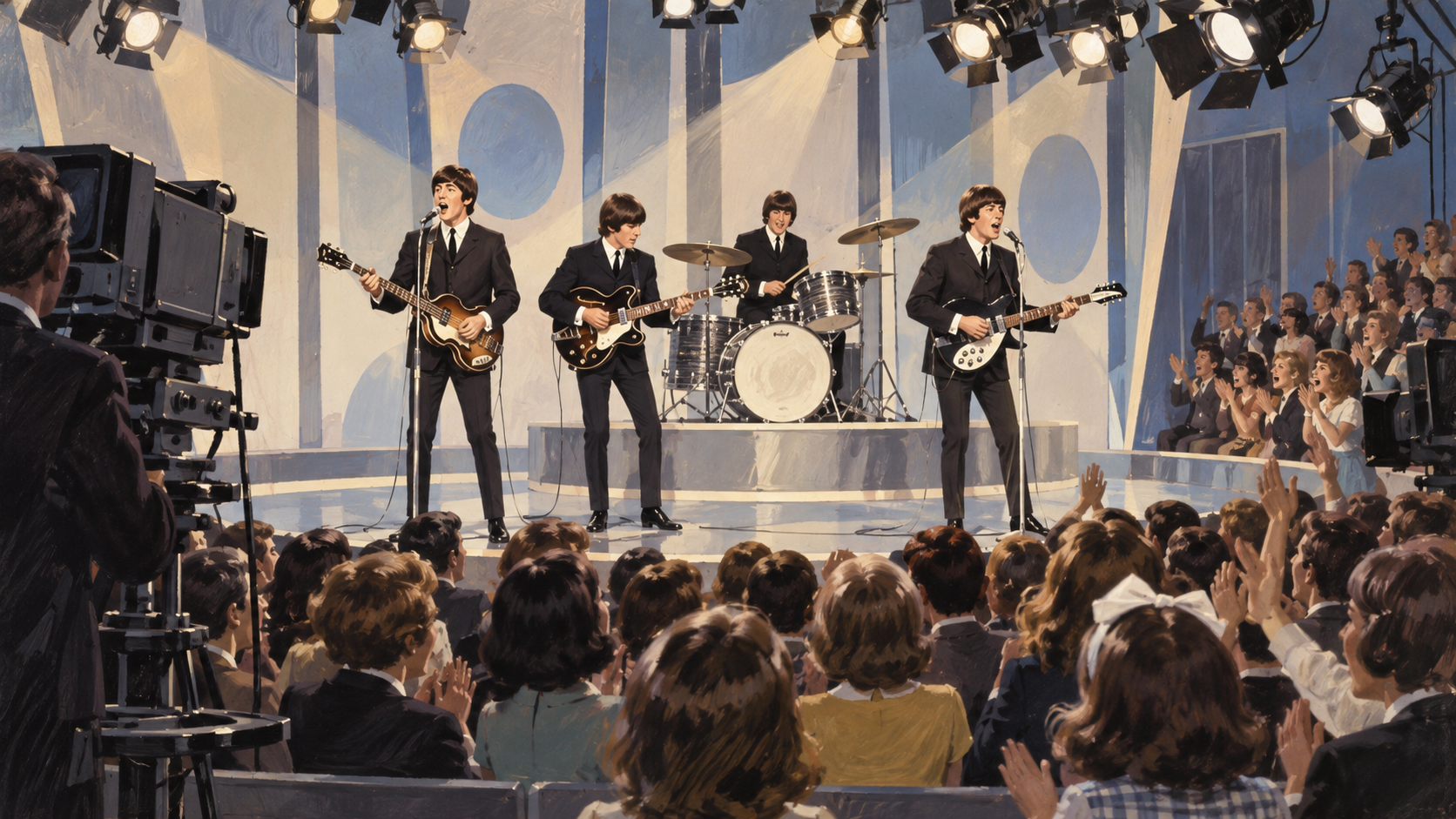
On February 9, 1964, the Beatles made their first live appearance on American television, performing on The Ed Sullivan Show from CBS Studio 50 in New York City. John Lennon, Paul McCartney, George Harrison, and Ringo Starr played before a packed studio audience while an estimated 73 million viewers watched at home. The broadcast arrived two days after the group landed at John F. Kennedy International Airport to screaming crowds, turning a successful British act into a national American phenomenon.
The Beatles had already transformed popular music in Britain, but American record releases initially received limited attention. That changed late in 1963 as radio stations began playing I Want to Hold Your Hand and Capitol Records launched a major promotional campaign. Ed Sullivan had witnessed the excitement surrounding the group in London and booked them for three appearances. Their first set included All My Loving, Till There Was You, She Loves You, I Saw Her Standing There, and I Want to Hold Your Hand.
The performance offered American audiences a carefully staged mixture of novelty and musicianship. Close camera work introduced each member, while the audience's continuous cheering became part of the broadcast's drama. For many young viewers, the Beatles' hair, humor, self-contained band format, and original songs represented a clear break from established entertainment. The event accelerated record sales and helped open the American market to other British performers in what became known as the British Invasion.
The broadcast is often remembered as a shared national moment, though its meaning extends beyond ratings. It demonstrated television's ability to create mass cultural events and showed how recordings, radio, promotion, live performance, and youth identity could reinforce one another. American rock musicians later cited the appearance as an inspiration to form bands. The Beatles would continue changing popular music in the studio and on stage, but their February 9 debut remains the instant when millions of Americans encountered them together.
The group's U.S. breakthrough followed sustained British success, changing radio play, and a coordinated record-company campaign rather than a single lucky booking.
Ed Sullivan's Sunday-night program reached families across generations, giving the Beatles exposure far beyond existing teenage fans.
The broadcast paired disciplined live playing with unprecedented audience noise, producing an image television could repeat in news and entertainment coverage.
Estimated audience figures are enormous but should be understood as ratings-based measures rather than a precise count of individual viewers.
The appearance helped American labels, promoters, and audiences pay attention to a broader wave of British groups.
Its continuing legacy lies in the memory of television as a communal event capable of changing fashion, music, and aspirations overnight.
Explore more of "On This Day ..."
Discover more events from the same date across news, politics, technology, sports, and other fields. Each link highlights significant moments that shaped history on different fronts.