

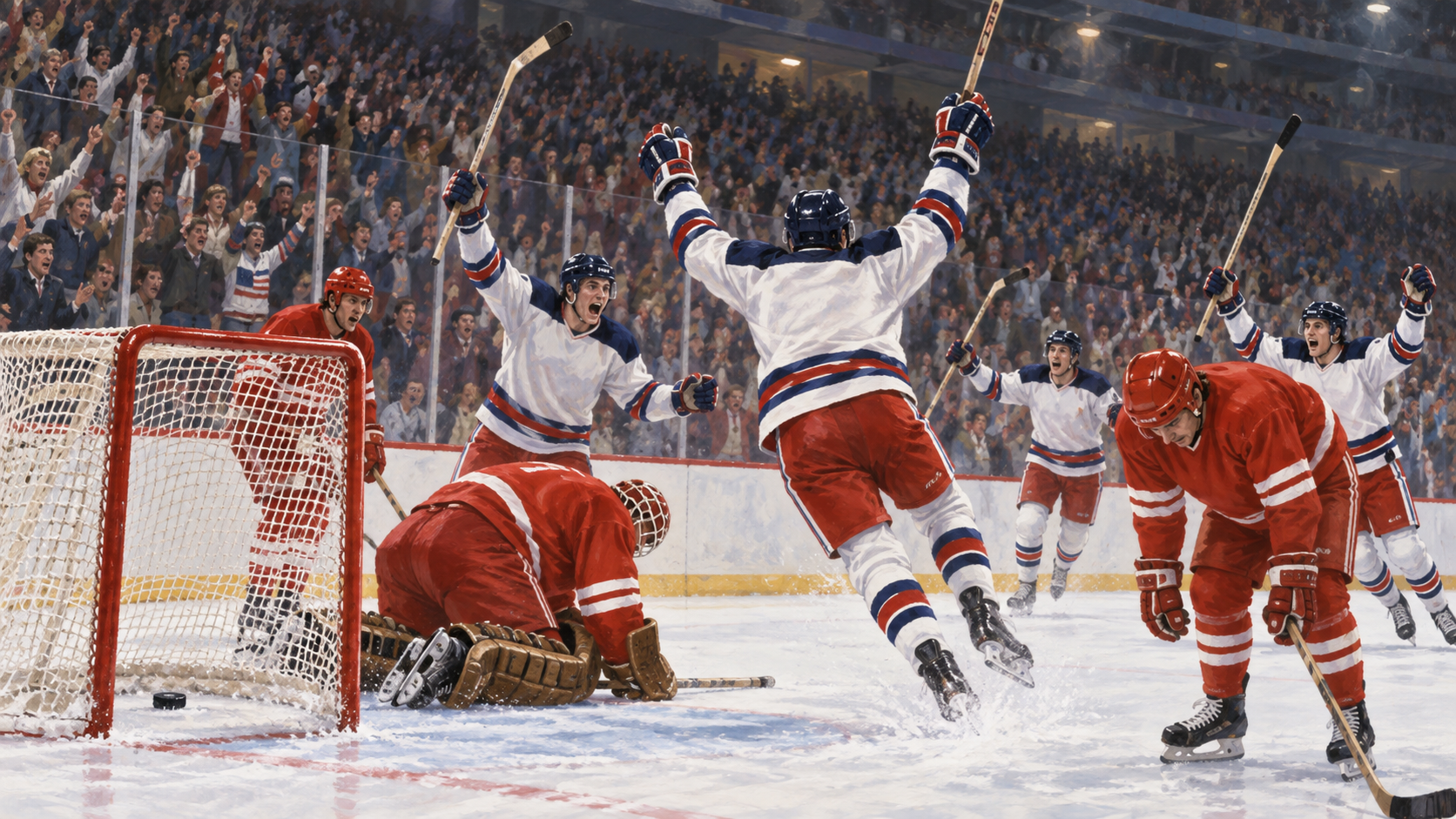
On This Day in News: February 22, 1980
On February 22, 1980, the United States men's Olympic hockey team defeated the Soviet Union 4–3 at Lake Placid, New York, in the game known as the Miracle on Ice. The American roster consisted largely of college players, while the Soviet team had dominated international hockey and won the previous four Olympic gold medals. A loud home crowd watched the Americans survive repeated pressure and take their first lead with ten minutes remaining.
Coach Herb Brooks had selected and trained the team for speed, conditioning, and disciplined play. The United States entered the medal round after an unbeaten preliminary stage but remained a clear underdog. In the first period, Mark Johnson tied the score at 2–2 with one second remaining. The Soviets replaced goaltender Vladislav Tretiak, widely regarded as the world's best, and moved ahead 3–2 in the second period.
Johnson scored again early in the third. Captain Mike Eruzione then shot past Vladimir Myshkin to give the United States a 4–3 lead. Goaltender Jim Craig and the defense protected it through the final Soviet attack. Broadcaster Al Michaels's call as time expired captured the disbelief surrounding the result. The victory did not itself award the gold medal; the United States still had to defeat Finland two days later and rallied to win 4–2.
The game became a major American sports story and a Cold War symbol during a period of tension over Afghanistan and the approaching Moscow Olympic boycott. That political meaning can overshadow the athletic achievement: careful preparation, team cohesion, and performance under pressure defeated a more experienced opponent. The Miracle on Ice remains a reminder that famous upsets are built through preparation rather than luck alone.
The Soviet team was not a casual collection of amateurs; it trained together extensively and had repeatedly defeated elite international opponents.
Brooks built the American roster around complementary skills and a demanding system rather than simply selecting the most famous players.
Goals at the end of the first period and early in the third kept the United States close enough to make Eruzione's winner decisive.
Because the Olympics used a medal-round format, beating the Soviet Union was essential but did not automatically secure gold.
The game gained symbolic force from Cold War tensions, although the players consistently emphasized hockey and team preparation.
Its legacy endures in sports culture as a model of belief, conditioning, tactical discipline, and collective performance.
Explore more of "On This Day ..."
Discover more events from the same date across news, politics, technology, sports, and other fields. Each link highlights significant moments that shaped history on different fronts.