

On This Day in Science: June 7, 2018
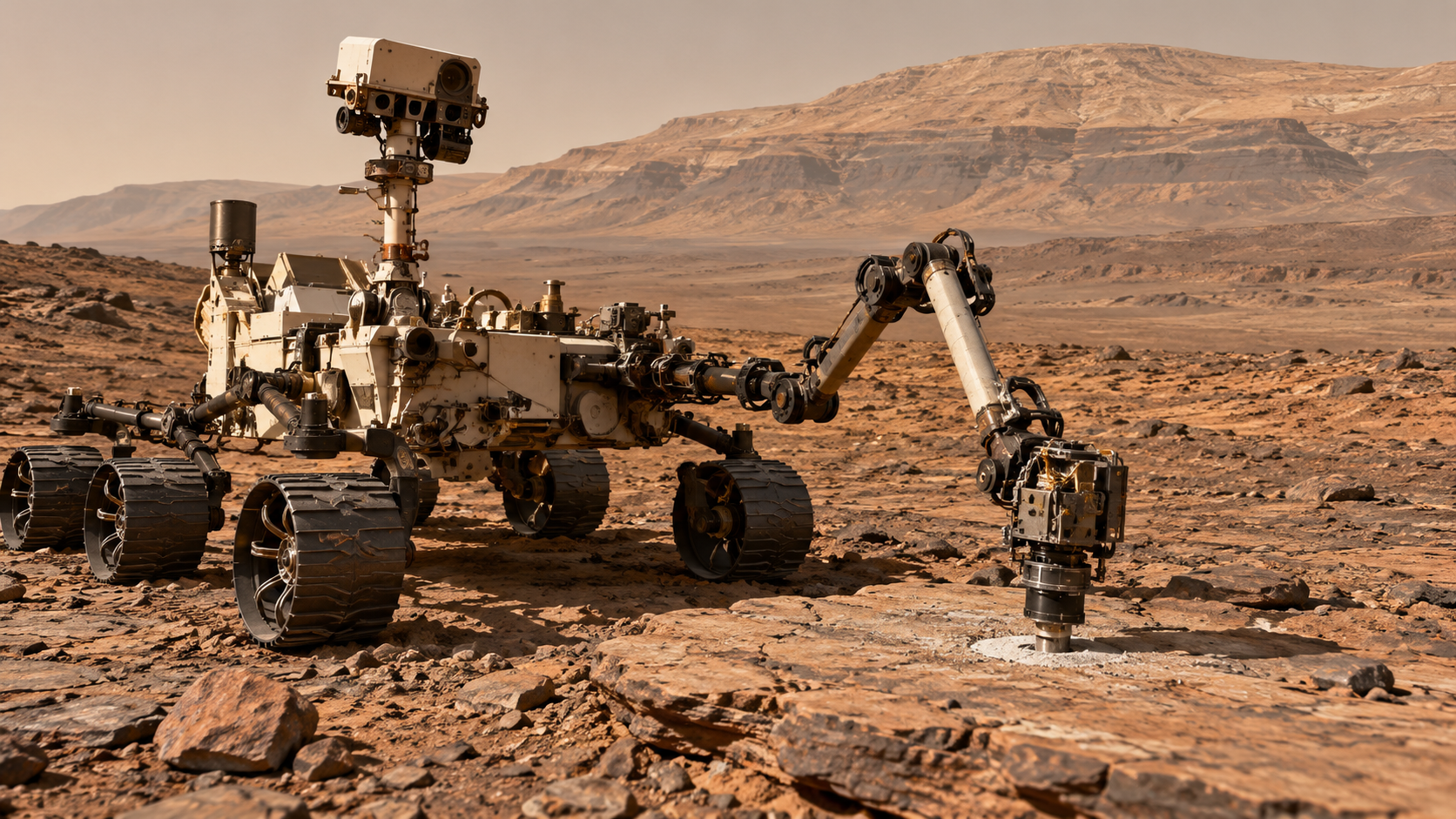
On June 7, 2018, NASA announced two results from the Curiosity rover: organic molecules preserved in ancient mudstone and a repeating seasonal pattern in atmospheric methane. The rover had drilled samples in Gale Crater and heated the powder inside its Sample Analysis at Mars laboratory, releasing compounds that instruments could separate and identify.
Organic molecules contain carbon and hydrogen, but they are not by themselves evidence of life. They can form through biological or nonbiological chemistry and can also arrive on meteorites. Curiosity found fragments containing sulfur that may have helped preserve the material in roughly three-billion-year-old lake sediments despite radiation and oxidation at the surface.
The methane result came from repeated measurements over several Martian years. Background levels rose and fell with the seasons, although short-lived spikes remained difficult to explain. Methane can be produced by geology, water-rock reactions, or biology, and the rover’s measurements did not identify the source.
Together the findings showed that ancient Mars preserved complex carbon chemistry and that its modern atmosphere was more dynamic than a single measurement would suggest. The careful distinction between detecting an ingredient and proving an origin is central to the continuing search for habitable environments. The anniversary highlights the difference between a first result and a finished understanding. A successful observation can settle one question while opening several harder ones, and even a failed objective can reshape later designs. Preserved data, specimens, photographs, and hardware allow new generations to revisit the work with better tools. Science advances through that continuity rather than stopping on a memorable date. Its calendar date is an entry point, not an endpoint. The people involved worked with the instruments, assumptions, and social conditions of their time, and later research has both extended and corrected their conclusions. Separating what was known that day from what became clear afterward protects the history from myth and shows how cumulative evidence turns an episode into lasting scientific knowledge. For science history, the event also shows how evidence moves from an observation or engineered test into a durable body of knowledge. Instruments supplied measurements, specialists debated interpretation, and later work refined what the first result could mean. Archives preserve the early record while new methods let researchers ask different questions of it. That continuing revision is the process through which a dated milestone remains scientifically useful. Seen across a longer timeline, scientific milestones are junctions rather than isolated beginnings. Earlier experiments, tools, and institutions made the work possible, while later teams tested limits and carried the result into new settings. What survives is a traceable chain of evidence, correction, and application that allows one moment to remain relevant as knowledge and technology continue to change.
Curiosity drilled ancient lake deposits and heated powdered samples in a miniature laboratory.
Released fragments revealed organic compounds that had survived for billions of years.
Both living systems and nonbiological processes can create carbon-rich molecules.
The detection establishes chemistry and preservation, not a biological source.
Repeated atmospheric measurements showed a low background that varied through the Martian year.
Possible sources remain geological, chemical, or biological and are not yet resolved.
Explore more of "On This Day ..."
Discover more events from the same date across news, politics, technology, sports, and other fields. Each link highlights significant moments that shaped history on different fronts.