

On This Day in Science: October 10, 1846
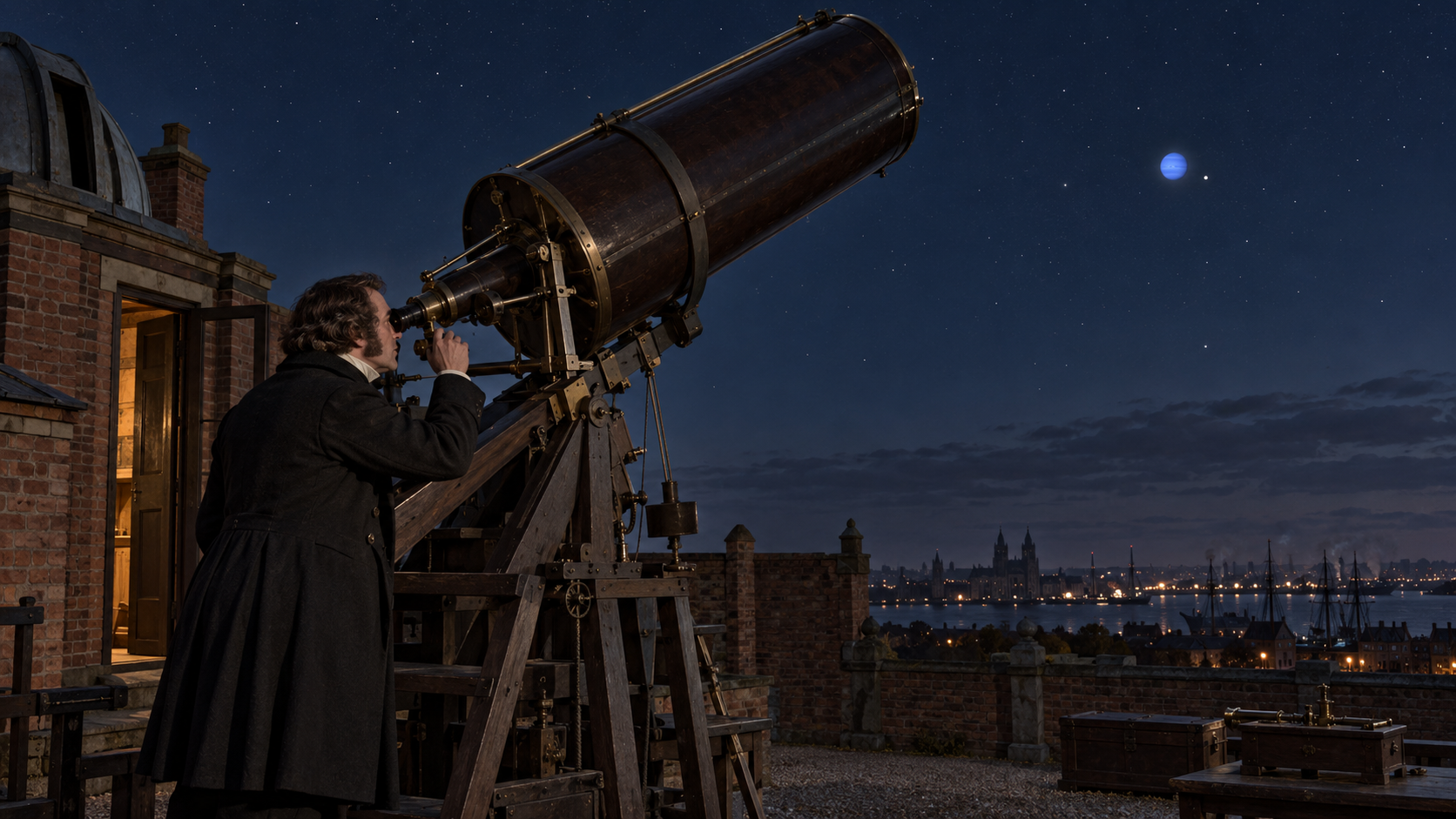
On October 10, 1846, English astronomer William Lassell discovered a moon orbiting Neptune from his private observatory near Liverpool. The observation came only seventeen days after Johann Galle and Heinrich d’Arrest identified Neptune near Urbain Le Verrier’s predicted position.
Lassell used a large reflecting telescope of his own construction. By comparing repeated views, he established that the faint point moved with the new planet. The moon was later named Triton and proved to be Neptune’s largest satellite.
Triton follows a retrograde orbit, moving opposite Neptune’s rotation. That unusual direction strongly suggests it formed elsewhere and was captured. Voyager 2’s 1989 flyby revealed a young, icy surface, a thin nitrogen atmosphere, and active plumes rising above the south polar region.
The discovery rapidly turned Neptune from a solitary predicted planet into a planetary system. Triton’s strange orbit and geology now make it a key example of how captured worlds can reshape the moons and rings around a giant planet. Its calendar date is an entry point rather than an endpoint. The people involved worked with the tools, assumptions, institutions, and social conditions of their time. Later research has extended some conclusions and corrected others, showing how science advances by keeping evidence open to comparison instead of treating a memorable event as final. What makes the event scientifically important is not only priority, but the ability of others to check, repeat, compare, or build on the result. That process can reveal limitations hidden by the excitement of a first success. It also explains why careful archives and transparent measurements matter as much as the date remembered by the public. Modern interpretations benefit from evidence that the original participants did not possess. New instruments and analytical methods can recover additional detail, while historical scholarship clarifies questions of credit, context, and consequence. Holding the original achievement and those later corrections together produces a more accurate account than either celebration or dismissal alone. The anniversary also illustrates how a scientific milestone becomes useful through records that later researchers can inspect. Instruments, notebooks, images, specimens, and engineering reports preserve more than a celebratory date: they show what was actually measured, what remained uncertain, and how conclusions changed as better methods became available. Placed in a longer timeline, the event was a junction rather than a finished answer. Earlier discoveries and technical work made it possible, while later teams tested its limits and applied the result in new settings. That traceable sequence of evidence and revision is what turns one day into a durable part of scientific history.
Lassell constructed and operated a powerful reflecting telescope.
Repeated observations separated a moving moon from fixed background stars.
Triton travels around Neptune in the direction opposite the planet's rotation.
The geometry points to capture rather than formation in place.
Voyager 2 saw smooth terrain, a thin atmosphere, and dark plumes.
Those findings made Triton a compelling target for future outer-planet exploration.
Explore more of "On This Day ..."
Discover more events from the same date across news, politics, technology, sports, and other fields. Each link highlights significant moments that shaped history on different fronts.