

On This Day in Tech: November 8, 1895
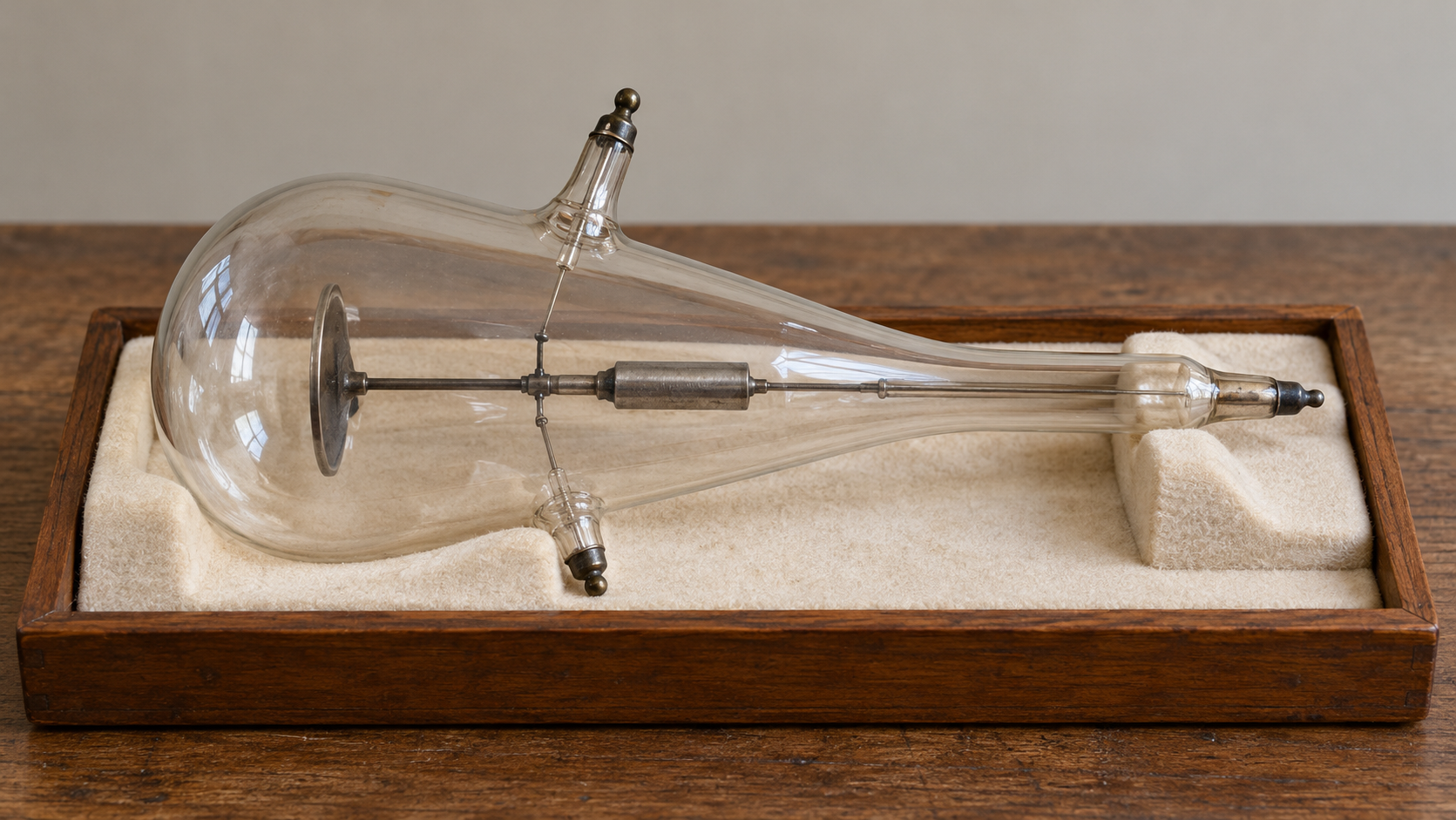
On November 8, 1895, physicist Wilhelm Conrad Röntgen observed an unexpected effect while experimenting with an electrical discharge tube at the University of Würzburg in Germany. Although the tube was covered to block its visible light, a nearby fluorescent screen responded when the apparatus operated. Röntgen investigated the effect rather than dismissing it as a stray reflection. He concluded that an unfamiliar form of radiation was escaping from the tube and passing through material opaque to ordinary light. The observation began the work that introduced X-rays, an important discovery in physics and the foundation of a new family of imaging technologies.
The apparatus belonged to an established field of research on electricity passing through gases at low pressure. Glass tubes with electrodes could produce luminous effects when connected to high-voltage equipment. Investigators studied the behavior of cathode rays and the fluorescence they caused. Röntgen’s distinctive contribution was recognizing and systematically testing radiation that could reach outside the covered tube. A fluorescent screen provided an immediate indication, while photographic materials offered a way to retain an image. The new method did not simply photograph a brighter version of an ordinary scene. Different materials absorbed the radiation differently, allowing concealed structures to produce contrasting patterns on a detector.
The first observation was followed by weeks of experiments. Röntgen examined the radiation’s ability to pass through substances and leave photographic records before submitting his initial scientific communication in December 1895. Early images of a hand became famous demonstrations of the method, but the discovery date should not be confused with every later experiment, public demonstration, or clinical application. The equipment was also far removed from a modern hospital installation. Early tubes and electrical supplies could be unstable, image quality varied, and the biological hazards of exposure were not yet properly understood. Detecting an invisible phenomenon and making a useful instrument from it were related but separate achievements.
News of the work spread rapidly, and researchers and physicians adapted X-rays to locate fractures and foreign objects without exploratory surgery. Industrial inspection and scientific investigations developed alongside medical uses. Subsequent progress depended on improved tubes, generators, detectors, shielding, and procedures for controlling exposure. Röntgen received the first Nobel Prize in Physics in 1901, years after the observation recalled here. November 8 marks an experimental discovery that changed what instruments could reveal beneath a surface. Its technological legacy lies not only in an image of bones but in the larger principle of using radiation and material interaction to gather otherwise inaccessible information. The history also shows why effective imaging requires control, interpretation, and safety measures as well as a source of penetrating rays.
Electrical discharge tubes were already research instruments. Röntgen noticed an effect outside a covered tube that existing expectations did not explain.
The discovery occurred at Würzburg on November 8, 1895. Publication and public demonstrations followed later.
Materials absorb X-rays differently, allowing hidden structures to produce contrasting detector responses. Fluorescent screens and photographic plates offered different ways of observing the effect.
Early apparatus was unstable and exposure risks were poorly understood. It should not be presented as equivalent to modern controlled imaging equipment.
Medical, industrial, and scientific applications expanded after the announcement. Improved sources and detectors made the technique more reliable.
The useful system includes protection and interpretation, not just radiation generation. Röntgen's observation began a long process of instrument development.
Explore more of "On This Day ..."
Discover more events from the same date across news, politics, technology, sports, and other fields. Each link highlights significant moments that shaped history on different fronts.