

On This Day in Tech: December 21, 1968
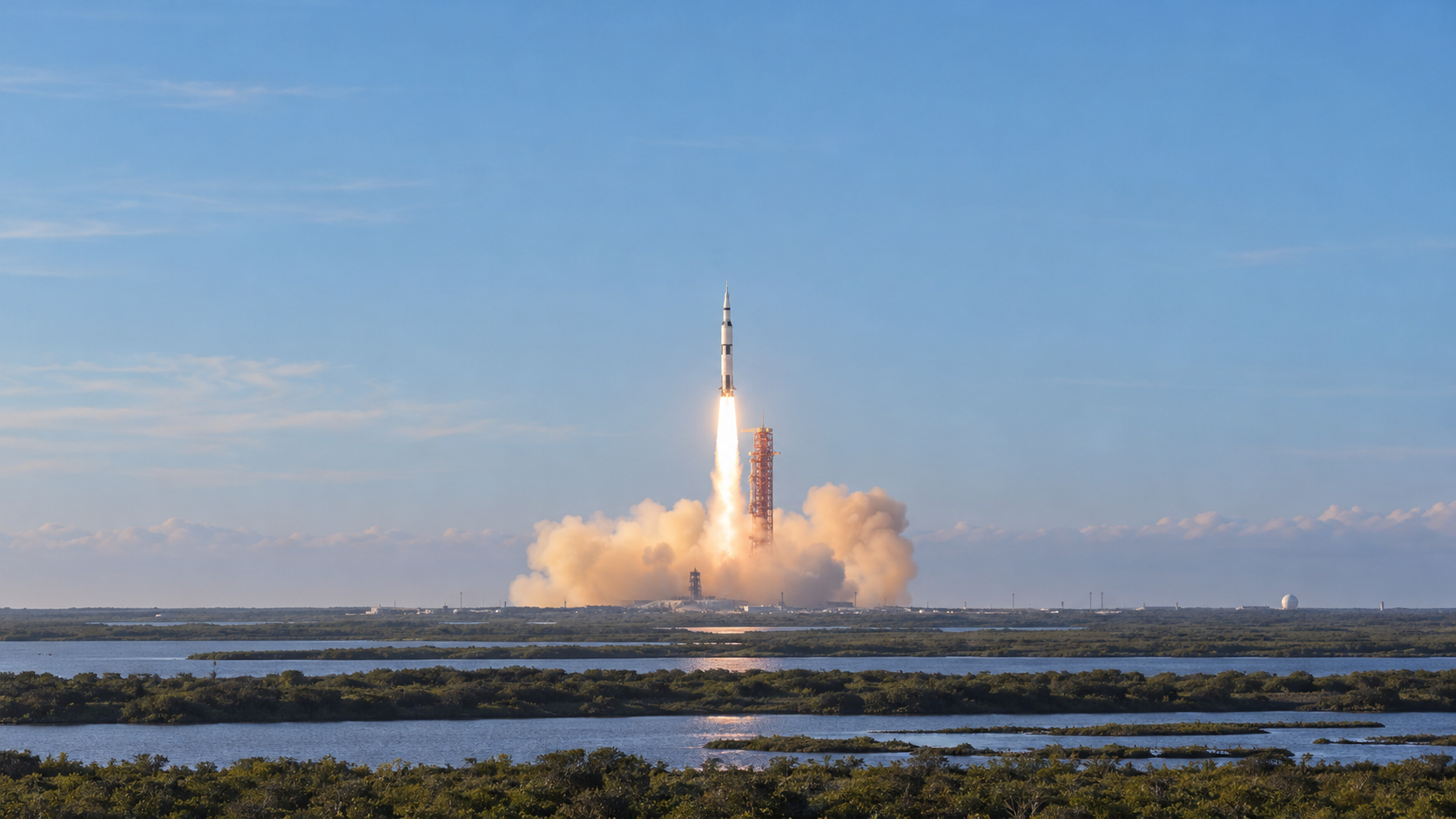
On December 21, 1968, Apollo 8 lifted off from Launch Complex 39A at Kennedy Space Center in Florida. Frank Borman, James Lovell, and William Anders rode a Saturn V rocket on the first crewed flight of that launch vehicle. Their destination made the mission especially consequential: after checking the spacecraft in Earth orbit, they would leave for the Moon. The departure began the first journey to lunar orbit by human beings. It did not carry a lunar landing vehicle, and the astronauts would not descend to the surface. Instead, the mission tested whether people and spacecraft could safely make the larger trip.
The Saturn V accomplished its work through a sequence of stages. Its first stage supplied the enormous thrust needed to rise from the pad, while later stages continued accelerating the spacecraft as spent hardware fell away. The third stage first helped establish an Earth orbit, giving the crew and ground controllers time to examine the vehicle before committing to the next maneuver. That pause was an essential part of the flight plan. Reaching an initial orbit did not by itself mean that the command and service module was ready for a mission much farther from home and beyond the possibility of a quick return.
Following the checks, the third stage restarted to perform translunar injection, sending Apollo 8 toward the Moon. The crew then separated the spacecraft from the spent stage and continued the coast under its own systems. Navigation, electrical power, temperature control, communications, and propulsion all had to function as an integrated whole. Ground controllers tracked the flight, but the astronauts also carried out observations and navigation tasks aboard the spacecraft. On December 24, the service module engine slowed the vehicle into lunar orbit. The crew completed ten revolutions before another engine burn put them on a route back to Earth.
The mission ended with a Pacific Ocean splashdown on December 27. Its successful return established operational experience that later landing missions could build upon, while photographs and observations supplied additional information about the Moon. The famous Earthrise image belongs to the later lunar-orbit phase, not the December 21 launch itself. On this anniversary, the technological milestone is the departure and the decision to continue beyond Earth orbit after verifying the spacecraft. Apollo 8 showed how a spectacular launch depended on disciplined checks, carefully timed propulsion, reliable communications, and coordinated work between a small crew and many specialists on the ground.
Apollo 8 was the first crewed Saturn V flight. Earlier launches had tested the enormous rocket without astronauts aboard.
The spacecraft did not carry an operational lunar module. The mission was a lunar-orbit rehearsal, not an attempted landing.
An initial Earth orbit provided time for system checks. Translunar injection was a later maneuver performed by restarting the third stage.
The command and service module separated after the departure burn. Its own propulsion and support systems then had to sustain the journey.
Lunar orbit began on December 24, three days after launch. Earthrise photography belongs to that later portion of the flight.
Returning safely mattered as much as reaching the Moon. The December 27 splashdown completed the test of an outward-and-homeward mission.
Explore more of "On This Day ..."
Discover more events from the same date across news, politics, technology, sports, and other fields. Each link highlights significant moments that shaped history on different fronts.