

OLED Pixels Explainer
An organic light-emitting diode display creates light inside each pixel rather than filtering a lamp behind the panel. Every emitting subpixel is a tiny stack of electrodes and organic semiconductor layers. When the drive electronics apply the correct voltage, charges enter the stack from opposite sides. Electrons and electron vacancies, called holes, move through different layers and meet in an emissive material. Their recombination releases energy that excites molecules; when those molecules return to a lower energy state, they emit photons. The material and device structure determine the color.
One electrode must let the generated light escape. Many panels use a transparent or semi-transparent electrode on the viewing side and a reflective electrode behind the organic layers. Hole-injection, hole-transport, emissive, electron-transport, and electron-injection layers guide charges toward the recombination zone. Each layer may be only nanometers thick. Efficient design balances electrons and holes so energy is released where light can leave the device instead of becoming heat or being lost at an interface.
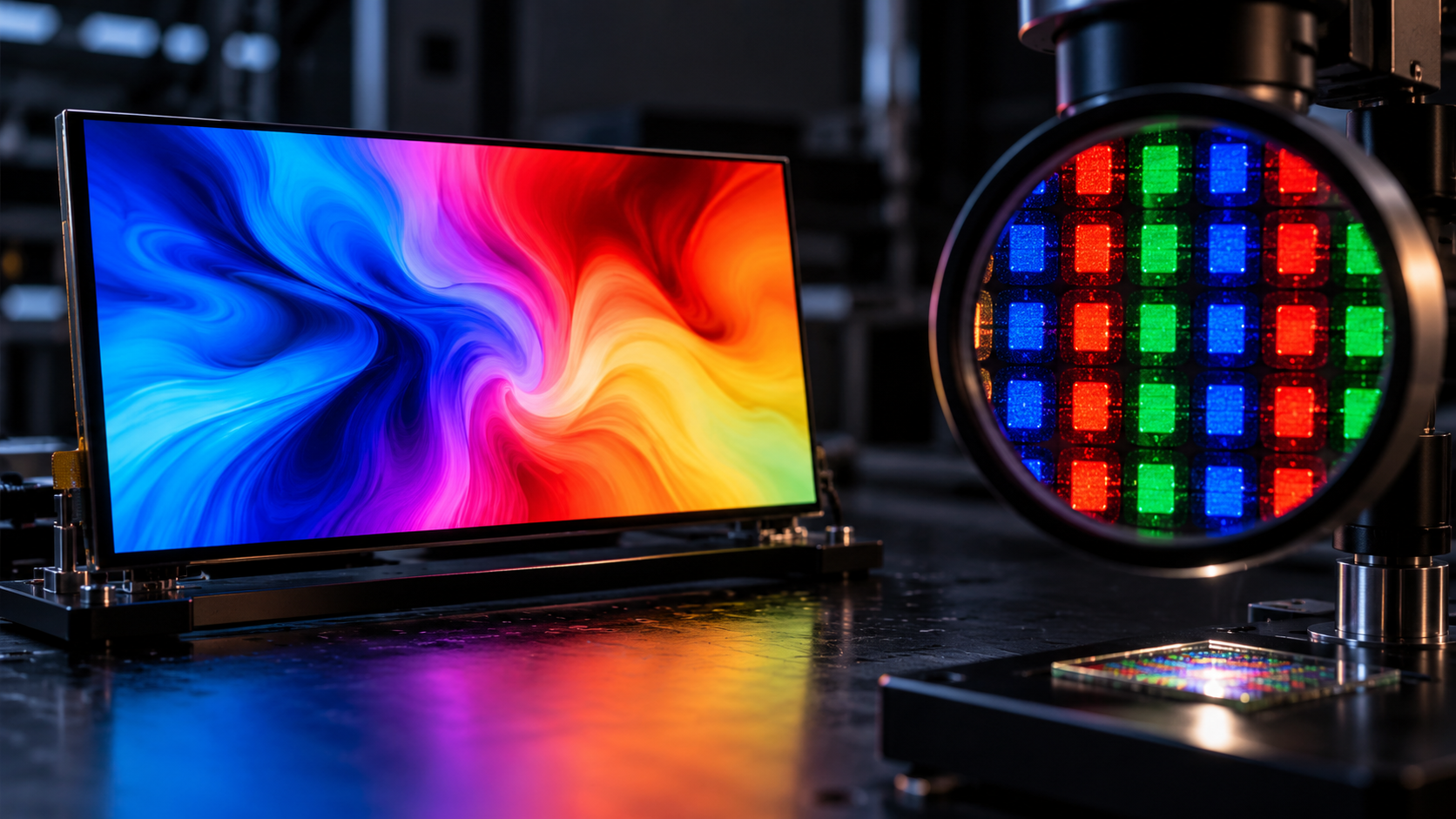
A color display divides a pixel into subpixels. Red, green, and blue emitters can be patterned separately, or a common emitter can be combined with color conversion or filters, depending on the panel type. By varying the current through each subpixel, the display mixes a wide range of colors. The relationship between current and visible brightness is managed by the panel electronics and calibration data. Subpixel shapes and counts may differ from a simple stripe, so apparent sharpness depends on layout as well as the published pixel resolution.
Active-matrix OLED panels place thin-film transistors and storage capacitors at each subpixel. A row-and-column addressing system writes a desired level into that circuit, and the transistor regulates current during the frame. Because the display can switch a pixel fully off, black areas emit almost no light and can sit next to bright details with little backlight leakage. That self-emissive behavior produces strong local contrast and wide viewing angles. It also means a bright image draws more panel power than a mostly dark image.
Organic emitters age as they operate. High current, heat, oxygen, moisture, and accumulated use can reduce efficiency or shift color. Blue materials have historically been especially challenging. Manufacturers seal the stack from air, distribute wear with pixel shifting or compensation algorithms, and calibrate drive levels as the panel ages. Persistent interface elements can create uneven wear that appears as image retention or burn-in. The risk depends on content, brightness, temperature, duty cycle, and the panel’s protective behavior.
OLED is a family rather than one identical construction. Phones may use flexible plastic substrates, televisions may use different emitter and color-conversion strategies, and microdisplays may deposit OLED structures on silicon backplanes. Some products arrange filters or quantum-dot conversion above a blue emitting stack. These engineering choices trade brightness, efficiency, lifetime, resolution, yield, and cost. The self-emissive principle remains the same even when the subpixel architecture and manufacturing sequence differ substantially.
The picture begins with charge control at microscopic scale. The backplane selects a subpixel, electrodes inject charges, organic layers bring them together, and excited molecules release colored light. Turning current down dims that subpixel; stopping it produces black. The absence of a full-panel backlight enables thin construction and per-pixel contrast, while organic material limits create lifetime and uniformity challenges. OLED quality therefore depends on both light-emitting chemistry and the transistors, sealing, calibration, and compensation that keep millions of tiny emitters behaving consistently.
Explore more "Explainers"
Discover additional explainers across politics, science, business, technology, and other fields. Each explainer breaks down a complex idea into clear, everyday language—helping you better understand how major concepts, systems, and debates shape the world around us.