

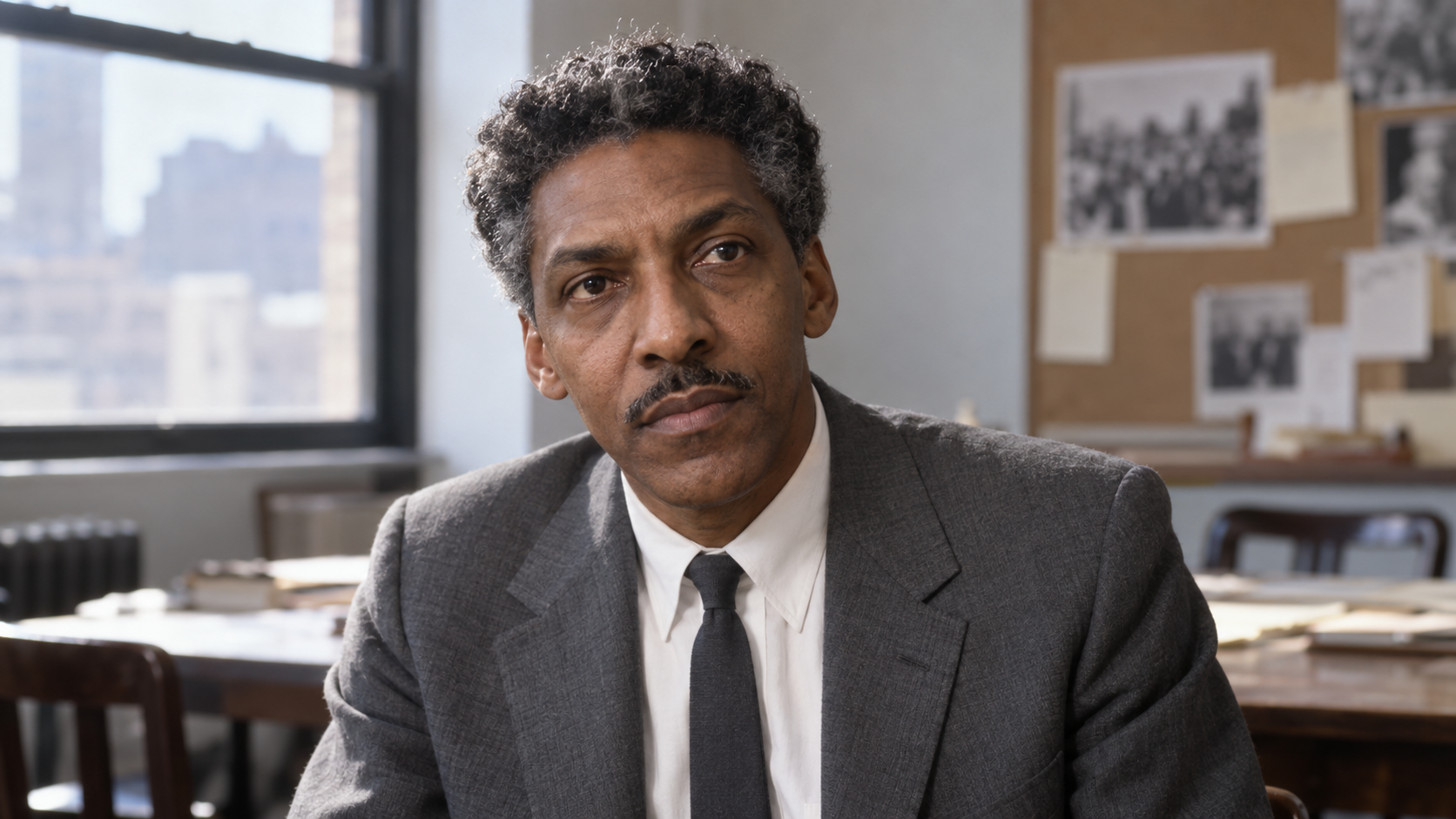
“We need in every community a group of angelic troublemakers”
Bayard Rustin’s call for angelic troublemakers gives an unsettling task a deliberately hopeful name. The opening clause quoted here appears in a recorded statement reproduced by Illinois Public Media, which identifies the setting as New York City in 1963. Rustin continues by describing disruption through nonviolent action. Walter Naegle’s account for the American Friends Service Committee also preserves the call and connects it with Rustin’s organizing. The excerpt therefore belongs to an argument about collective pressure, rather than a recommendation to cause trouble for its own sake. Its subject is the capacity of ordinary people to challenge arrangements that sustain injustice.
The two words at the center of the phrase pull in different directions. Angelic suggests moral purpose and concern for others; troublemakers suggests an interruption of the expected order. Rustin brings them together because a peaceful appearance can coexist with deeply unfair conditions. A demand for quiet may protect those conditions instead of correcting them. Nonviolent protest can interrupt routines while refusing the use of weapons against opponents. That approach requires preparation and discipline, not merely a spontaneous expression of anger. The quotation’s charm should not conceal the seriousness of asking people to take risks together in pursuit of a public goal.
Rustin’s reference to every community also distributes responsibility. Reform need not wait for one national figure to identify each local problem and arrive with a complete solution. Residents can learn how an institution works, gather evidence about its effects, and organize around a specific demand. As a present-day interpretation, this can include public attendance at meetings, coordinated petitions, or lawful demonstrations that make an ignored issue visible. The method should fit the circumstances and respect the safety and rights of others. Organization becomes more credible when participants can explain both the injustice they oppose and the change that would address it.
There is a lesson here about the difference between being agreeable and being constructive. A person who always avoids discomfort may leave a harmful practice undisturbed. Someone who challenges it can create tension while helping a community confront a problem it has preferred not to see. That does not mean every disruptive act is wise or every protest demand sound. Evidence, clear objectives, and accountability still matter. Rustin’s phrase asks us to hold those standards alongside the willingness to act. The troublemaker’s purpose is to make a more just arrangement possible, and the moral adjective requires that purpose to remain visible in the means chosen.
This is the opening clause of a recorded statement reproduced by Illinois Public Media, which dates its setting to New York in 1963.
The American Friends Service Committee’s account by Walter Naegle also preserves the call. The surrounding argument advocates nonviolent disruption.
The phrase joins ethical purpose with a willingness to disturb unjust routines. Rustin did not present weapons as the means of pressure in this passage.
The reference to every community places organizing close to ordinary people. Local knowledge and collective preparation become political resources.
An applicable question is whether an ignored problem needs organized public attention, and what specific change participants seek.
Constructive challenge requires discipline as well as courage. The purpose and methods should remain open to examination by the community affected.
Explore more "Quotes of The Day"
Discover more notable quotes from influential voices across politics, science, business, technology, sports, and culture. Each quote offers insight into how ideas, beliefs, and decisions shape the world around us.