

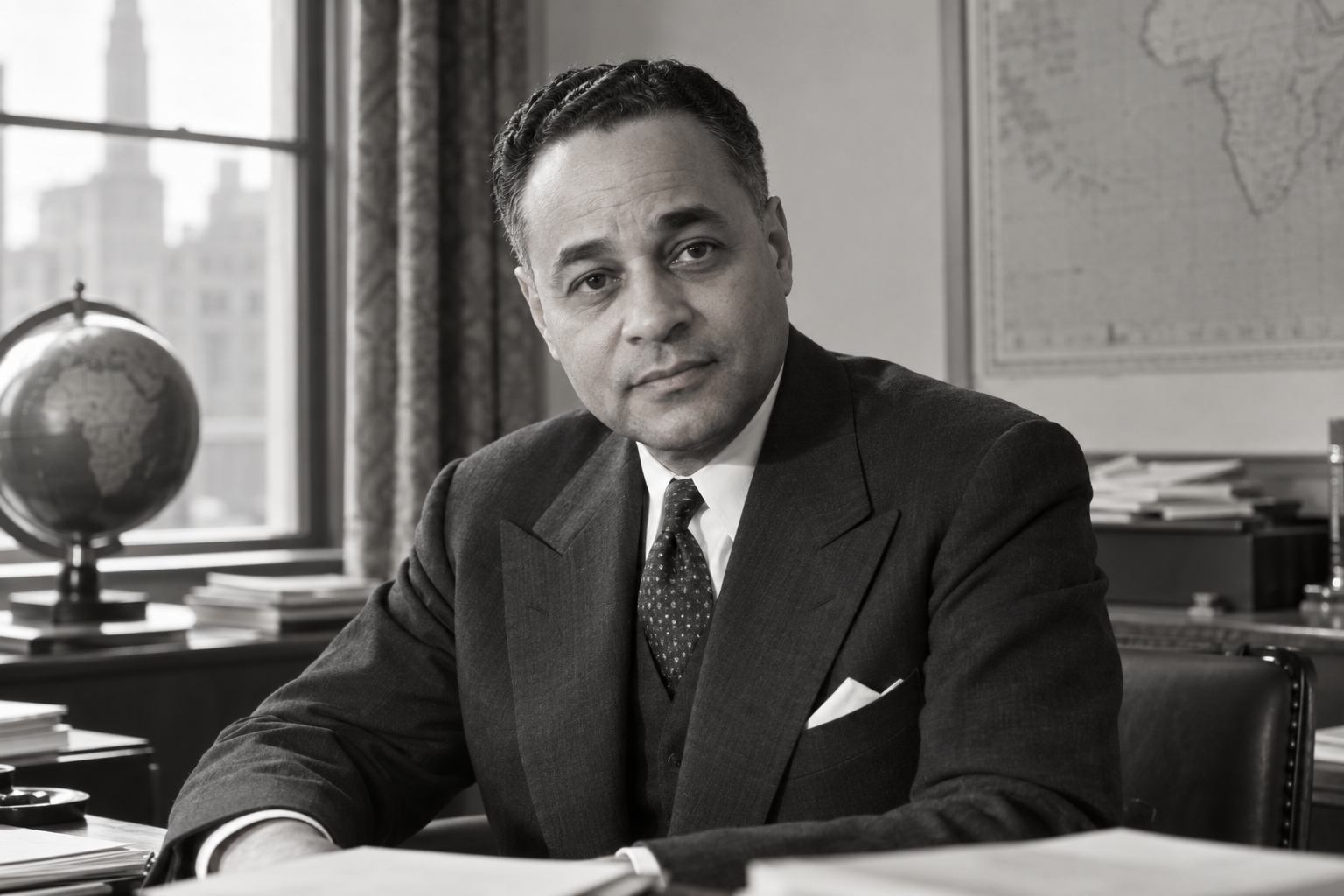
“What, then, could war achieve which could not be better gained by peaceful means?”
This question appears in the published full version of Ralph Bunche’s Nobel lecture, dated December 11, 1950. The Nobel archive notes that the lecture was shortened in delivery. Bunche, a United Nations official and mediator, was speaking in a world marked by the Cold War, fighting in Korea, and the destructive possibilities of atomic weapons. Near the passage, he argued that even survivors of an atomic war could not be understood as victors. His question shifts attention from the language of victory to the purpose of action. What result is sought, and could negotiation achieve it with less suffering and destruction?
The phrasing asks for a comparison rather than a ceremonial profession of support for peace. A leader may name security, freedom, or a settlement of competing claims as an objective. The next task is to examine the means proposed for reaching it. War imposes losses that do not disappear when an announcement declares success. A peaceful process has difficulties and costs of its own, but those should be compared with the consequences of violence rather than dismissed before consideration. Bunche’s question makes that examination a matter of political judgment. It encourages precision about objectives and requires a credible account of why less destructive approaches have not been sufficient.
The lecture did not simply reject every use of force. In discussing Korea, Bunche defended international action against armed aggression and called for support capable of making collective security effective. That context prevents the quotation from becoming a claim that he opposed all military action under all circumstances. His larger argument emphasized negotiation, mediation, and the work needed to create conditions in which they could succeed. The passage joins a warning about modern war with confidence in peaceful dispute resolution. Readers can consider that confidence critically while preserving the distinction between defending against aggression and treating war as an ordinary tool for securing national advantage.
The question remains demanding even when an answer seems obvious to the people making a decision. Have the goals been stated clearly enough to assess? What peaceful routes were attempted, and what blocked them? Who will bear the losses, and what would count as a durable result rather than an immediate gain? Such questions slow the movement from fear or anger to claims of necessity. They do not provide an automatic verdict for every conflict. They insist that public reasoning include alternatives and human consequences. Bunche’s formulation gives peaceful means a place in that reasoning which should be earned through serious effort and displaced only through equally serious explanation.
Bunche’s full published Nobel lecture is dated December 11, 1950. The archive explains that the version delivered in Oslo was shorter.
The passage followed a warning about atomic war. Its question examines whether destructive force can serve the ends claimed for it.
The lecture defended collective action against armed aggression in Korea. The quotation should not be read as opposition to every possible use of force.
Comparing means requires attention to aims, alternatives, and human costs. A declaration of victory is not a sufficient measure of success.
Decision-makers should explain what peaceful routes were explored. The people bearing losses deserve a clear account of necessity and purpose.
The question encourages sustained work on negotiation and mediation. It provides a discipline for judgment rather than a ready answer to every conflict.
Explore more "Quotes of The Day"
Discover more notable quotes from influential voices across politics, science, business, technology, sports, and culture. Each quote offers insight into how ideas, beliefs, and decisions shape the world around us.