

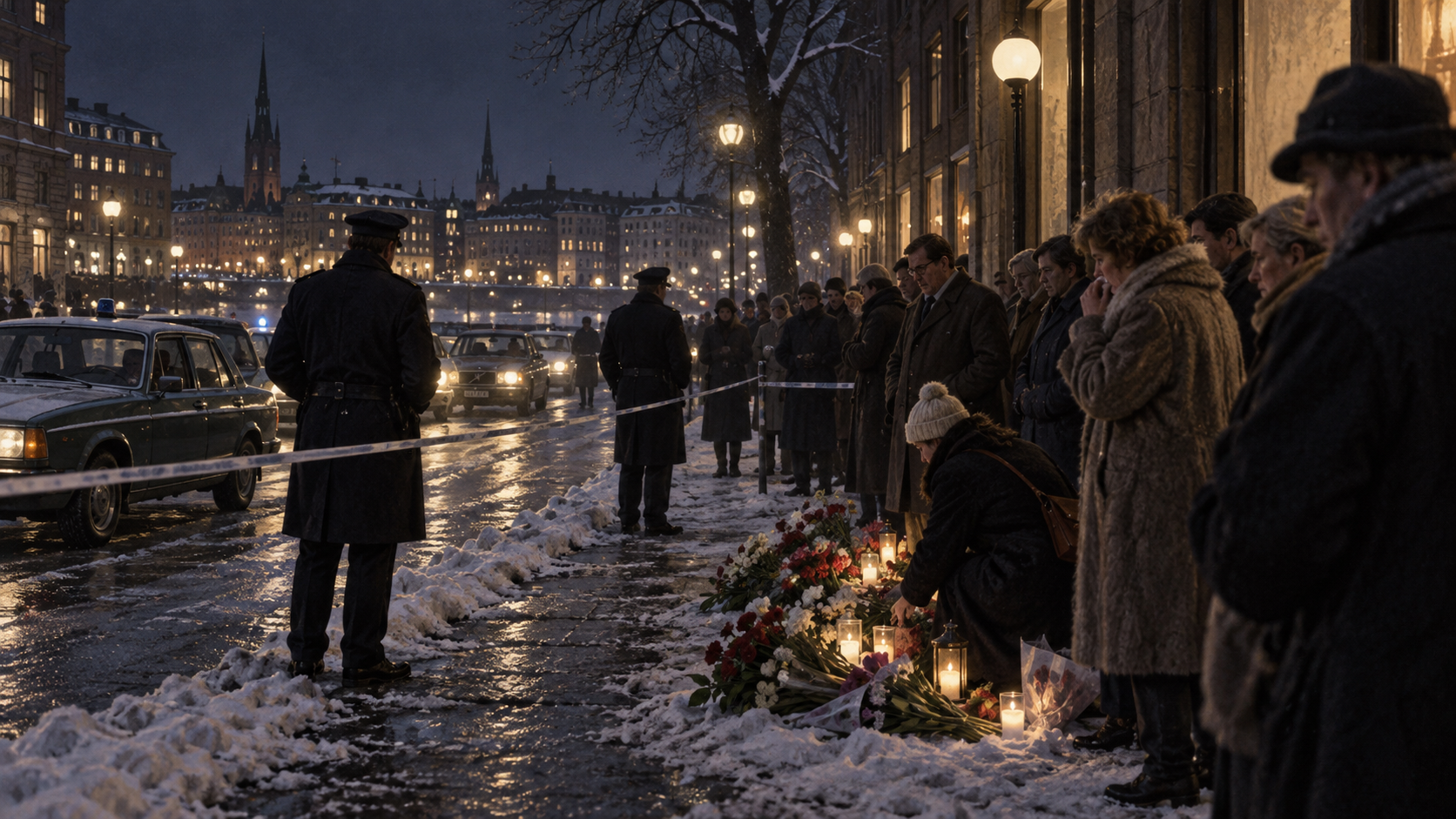
On This Day in News: February 28, 1986
On February 28, 1986, Swedish Prime Minister Olof Palme was shot and killed while walking home from a cinema in central Stockholm with his wife, Lisbet. The couple had no bodyguard detail with them. The attacker escaped into nearby streets, and Palme died soon after reaching a hospital. The assassination shocked Sweden, a country whose political culture and public life had generally seemed removed from such violence.
Palme had led the Social Democratic Party and served two periods as prime minister. He was known internationally for opposition to apartheid, criticism of the Vietnam War, support for decolonization, and advocacy of disarmament. At home, he defended Sweden's extensive welfare state but was also a polarizing figure. His prominent positions generated numerous theories about possible enemies, which complicated the investigation from its earliest days.
Police made major errors in securing the scene, coordinating leads, and preserving public confidence. A petty criminal, Christer Pettersson, was convicted in 1989 after Lisbet Palme identified him, but an appeals court overturned the verdict because of insufficient evidence. The inquiry continued for decades, producing an enormous archive and recurring speculation involving extremists, foreign governments, arms deals, and individual suspects.
In 2020, Swedish prosecutors closed the active investigation and named graphic designer Stig Engström, known as the Skandia man, as the likely killer. Engström had died in 2000 and could not be charged or questioned, and the evidentiary case remained disputed. Palme's death is remembered both as a national trauma and as a caution about investigative failure. February 28 changed Sweden's sense of openness and left an unresolved boundary between official conclusion and courtroom proof.
Palme's decision to walk without security reflected a political culture in which senior leaders maintained unusually direct contact with ordinary public life.
His international activism and domestic prominence created a wide field of possible motives, many of which generated durable but unproved theories.
The killer's escape and early mistakes at the scene deprived investigators of evidence and allowed leads to multiply without resolution.
Pettersson's overturned conviction illustrated the difference between suspicion, eyewitness identification, and proof strong enough to survive appeal.
The 2020 prosecutorial conclusion named a deceased suspect but could not produce a trial capable of testing the full case.
Palme's legacy includes both his political ideas and the lasting impact of an assassination that challenged Sweden's trust in public safety.
Explore more of "On This Day ..."
Discover more events from the same date across news, politics, technology, sports, and other fields. Each link highlights significant moments that shaped history on different fronts.