Ukraine-Russia Talks Resume in Abu Dhabi With Security Guarantees at Center
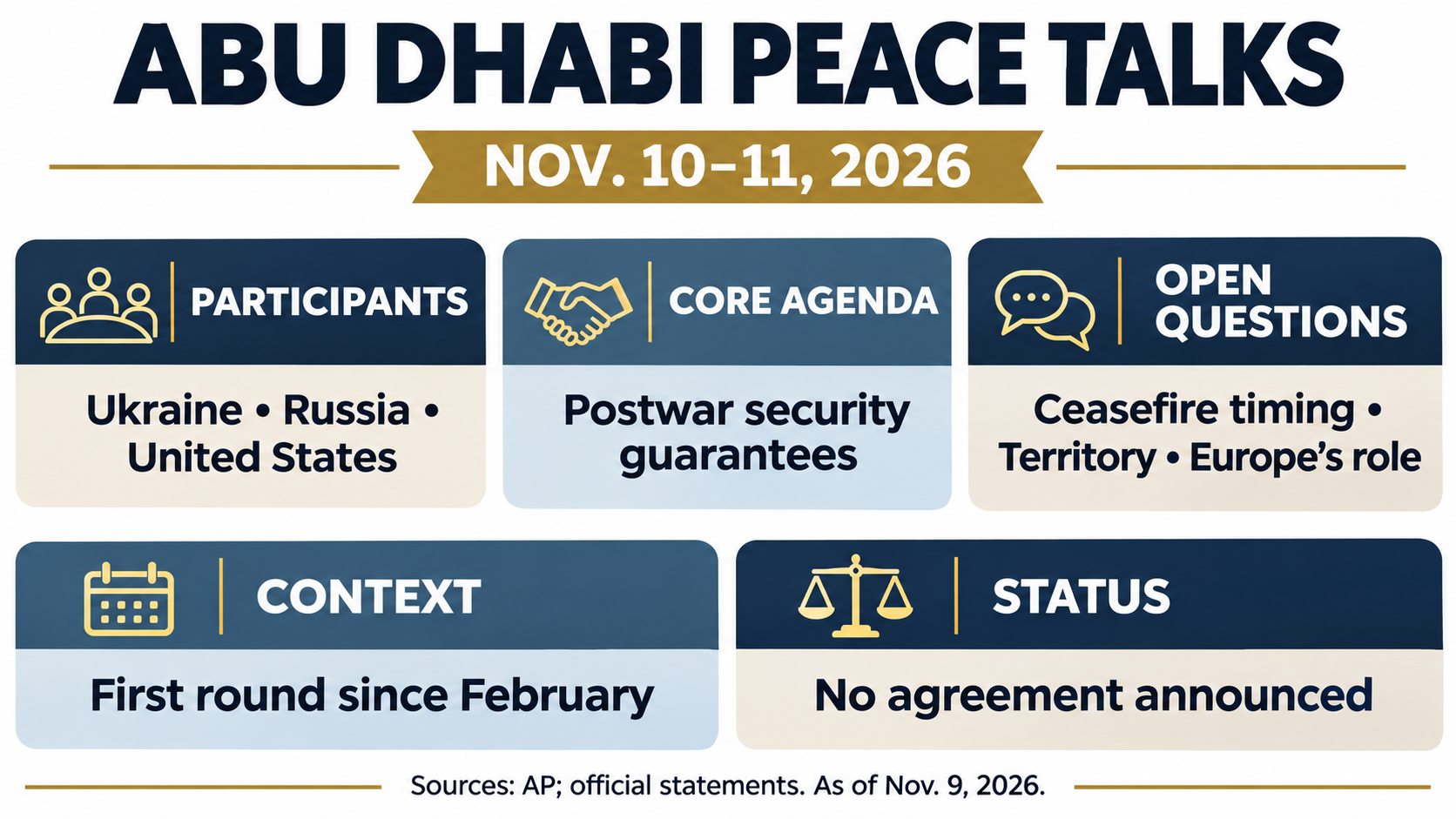
Russian, Ukrainian and U.S. negotiators are scheduled to meet in Abu Dhabi on Nov. 10–11 for the first trilateral round since February. The two-day session is expected to focus on postwar security guarantees: the commitments, monitoring systems and response mechanisms that would be needed to make any future settlement durable.
The meeting is a diplomatic opening, not a ceasefire announcement. Fighting and long-range strikes continue, and the parties remain far apart on the sequence of any settlement. Ukraine says a general ceasefire should come first and has pushed for a direct meeting between Presidents Volodymyr Zelenskyy and Vladimir Putin to resolve territorial questions. Russia says it wants a comprehensive settlement before a broad ceasefire and continues to demand Ukrainian withdrawal from four regions Moscow claims to have annexed, along with neutrality and limits on Ukraine’s armed forces. Kyiv rejects forced territorial cession and restrictions that would leave it vulnerable to another invasion.
Ukraine’s delegation is led by Rustem Umerov. Russia’s team is led by presidential aide Vladimir Medinsky, who also headed earlier rounds. U.S. envoys Steve Witkoff and Jared Kushner are central to the mediation effort. The presence of senior teams gives the session weight, but it does not erase the basic disagreements over territory, military posture and enforcement.
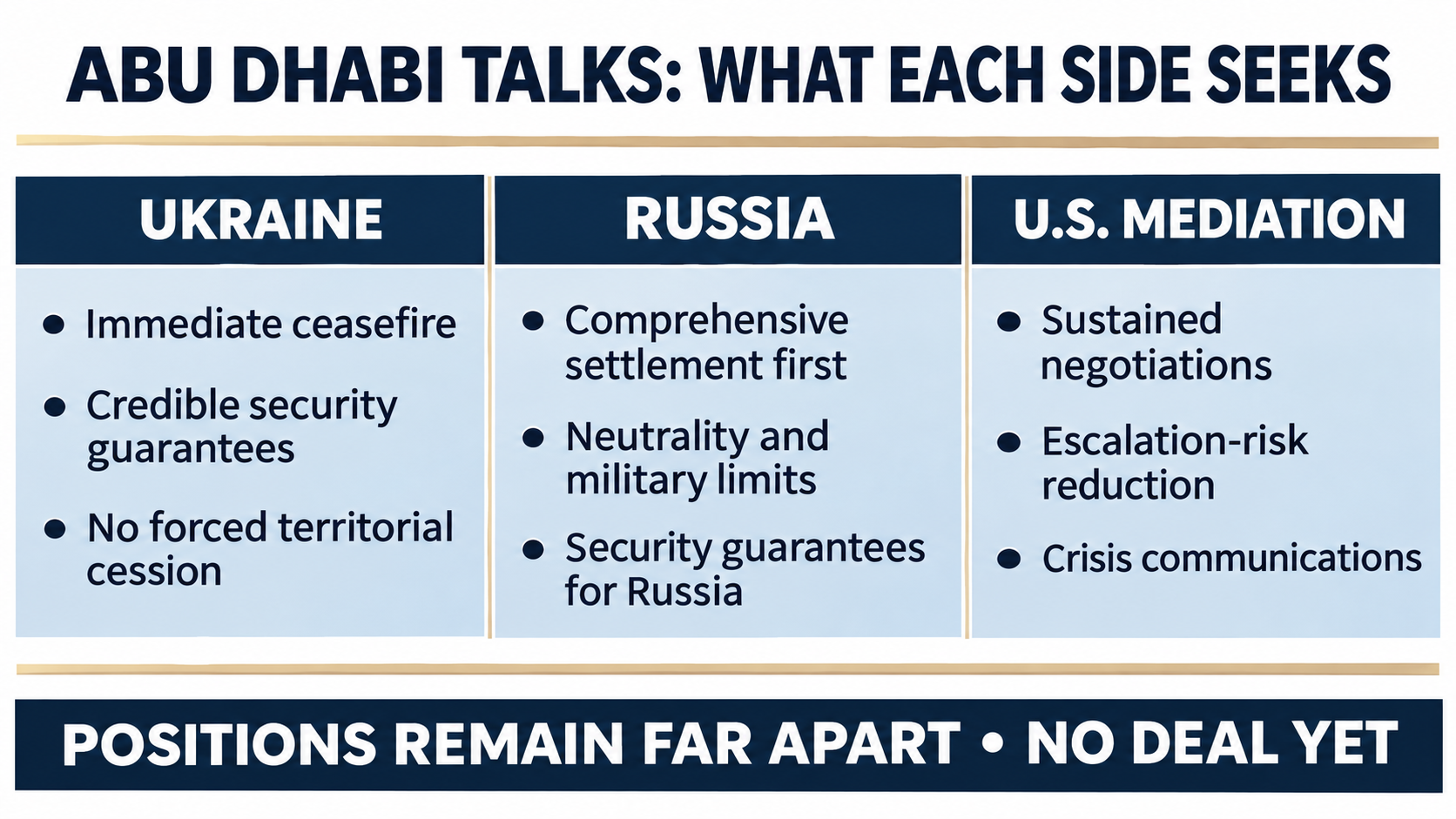
Security guarantees are the central technical and political question. Ukrainian officials have sought commitments strong enough to deter a renewed attack, sometimes describing the goal as protection comparable in effect to NATO’s Article 5. That does not mean Ukraine would automatically become a NATO member. NATO’s own explanation of Article 5 shows why wording and implementation matter: each ally has an obligation to assist an attacked member, but the form of assistance is determined by each state. Any Ukraine-specific arrangement would need its own clearly defined commitments.
Europe’s role is another unresolved issue. Ukrainian officials say European states must participate in decisions affecting the continent’s security and Ukraine’s recovery. German Foreign Minister Johann Wadephul made the same point before the G7 foreign ministers’ meeting in Paris. European envoys are expected to consult separately with the American side in Abu Dhabi rather than sit at the main trilateral table. The Kremlin has indicated European involvement may be necessary later, while opposing European troop deployments in Ukraine.
The talks follow weeks of preparation in Brussels and calls between Zelenskyy and the U.S. envoys. They also follow a limited humanitarian ceasefire around Russian-occupied Oleshky in October, which enabled evacuations and aid deliveries. That local arrangement showed that narrow, verifiable steps can be negotiated even while the wider war continues. It did not create a nationwide ceasefire or settle the conflict.
Abu Dhabi has hosted earlier trilateral talks and has repeatedly mediated captive exchanges. That record gives the United Arab Emirates experience as a venue and intermediary, but the latest round is attempting something broader than a humanitarian exchange. It must confront who verifies violations, what happens after a breach, how forces are separated, how civilians and infrastructure are protected, and which countries would carry enforcement responsibilities.
The most realistic near-term result may be a framework for continued talks, working groups or additional confidence-building measures rather than a final peace agreement. Any claim of a breakthrough should be tested against concrete language on ceasefire timing, territorial control, monitoring, security commitments and the participation of European governments. Until those elements are agreed and published, the meeting should be understood as a high-stakes negotiating round whose outcome remains open.
What Renewed Ukraine Peace Talks Could Mean for Civilians and Recovery
For families living near the front, displaced people weighing whether they can return home and communities facing another winter of attacks on energy systems, the Abu Dhabi talks matter most if they produce practical protection. The scheduled Nov. 10–11 meeting brings Ukraine, Russia and the United States back to the same negotiating format for the first time since February, but the talks alone do not make travel safer or stop strikes.
A civilian-centered agreement would need more than a political declaration. It would need clearly mapped evacuation and aid routes, rapid notification when fighting threatens those corridors, access for humanitarian teams and reliable procedures for investigating violations. The limited October ceasefire around Oleshky is relevant because it enabled evacuations and assistance in a defined area. Its narrow scope also shows the limits of a local arrangement while the broader war continues.
Energy security is an immediate community issue. Ukrainian officials have emphasized air defense and energy needs ahead of winter. Damage to electricity, heating and water systems can turn a military escalation into a public-health emergency within hours. Any ceasefire framework would therefore need rules protecting critical infrastructure, a way to verify attacks and a plan for emergency repairs.
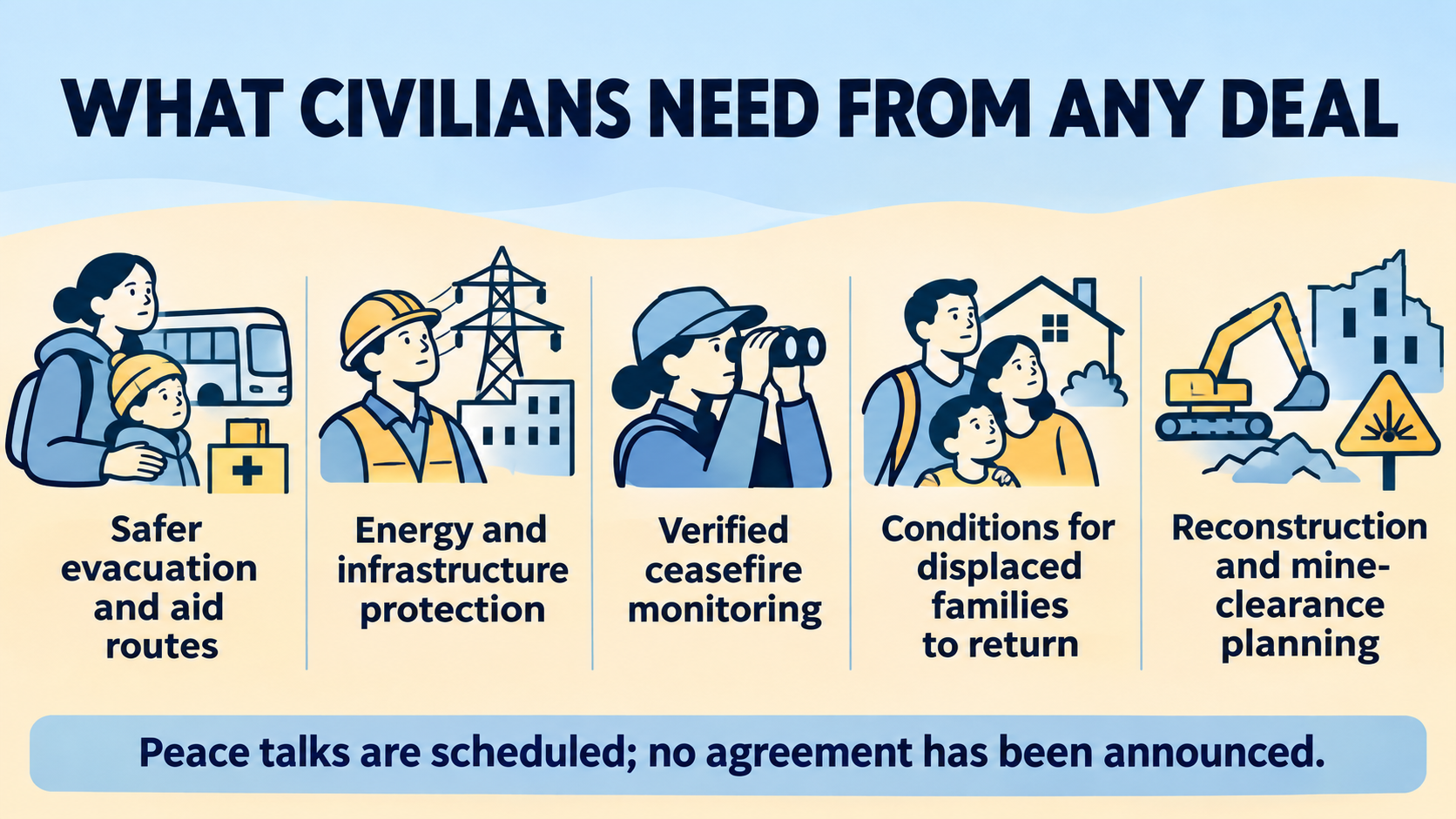
Displaced families face a different calculation. A ceasefire date does not automatically make a neighborhood safe. Return depends on mine clearance, stable utilities, functioning schools and clinics, housing assessments, legal access to property and confidence that fighting will not restart. People who cannot safely return also need predictable support in the communities where they are living now.
Captives, missing people and separated families remain another humanitarian track. The United Arab Emirates says its mediation has helped facilitate repeated captive exchanges, including a 540-person swap in October. That record does not resolve the political conflict, but it shows how specific, negotiated procedures can produce tangible results for families even without a comprehensive settlement.
Recovery planning will be tied to security. Governments, lenders and private investors are unlikely to commit at the scale Ukraine needs unless they understand what protects rebuilt power stations, homes, rail lines and hospitals. Ukrainian officials say Europe must be involved in both security guarantees and economic recovery. That position reflects a basic community concern: rebuilding is meaningful only if people believe new infrastructure will endure.
The talks may generate headlines before they generate relief. Residents should watch for measurable steps: a monitored pause in attacks, named humanitarian access points, procedures for reporting violations, schedules for captive exchanges and commitments to protect energy systems. Those details would show whether diplomacy is moving from broad positions toward changes people can experience.
For now, expectations should remain cautious. No nationwide ceasefire has been announced, and the core disputes over territory, military limits and enforcement remain unresolved. The community standard is straightforward: any deal should reduce immediate danger, preserve dignity and create conditions in which families—not negotiators—can safely decide what comes next.
Abu Dhabi Talks Test Ceasefire Design, Deterrence and European Security
The central security question in Abu Dhabi is not simply whether the sides can announce a pause in fighting. It is whether they can design commitments that survive pressure, reveal violations quickly and create credible consequences for renewed aggression. That requires a chain of implementation decisions that negotiators have not yet finalized.
Verification comes first. A broad ceasefire would need agreed lines, common definitions of prohibited activity, communications channels and an organization or group of states able to collect evidence. Technical monitoring can help track missile launches, drone activity, force movements and damage to infrastructure, but technology does not decide responsibility on its own. The parties would need a process for examining incidents and resolving conflicting claims before they trigger escalation.
Deterrence is the next layer. Ukraine wants guarantees strong enough to prevent another invasion and rejects military limits that would leave it exposed. Russia demands Ukrainian neutrality and restrictions on its armed forces while also seeking guarantees for its own security. These positions collide over the most basic feature of a postwar order: whether Ukraine can retain enough capability and external support to deter attack without arrangements Moscow portrays as a threat.
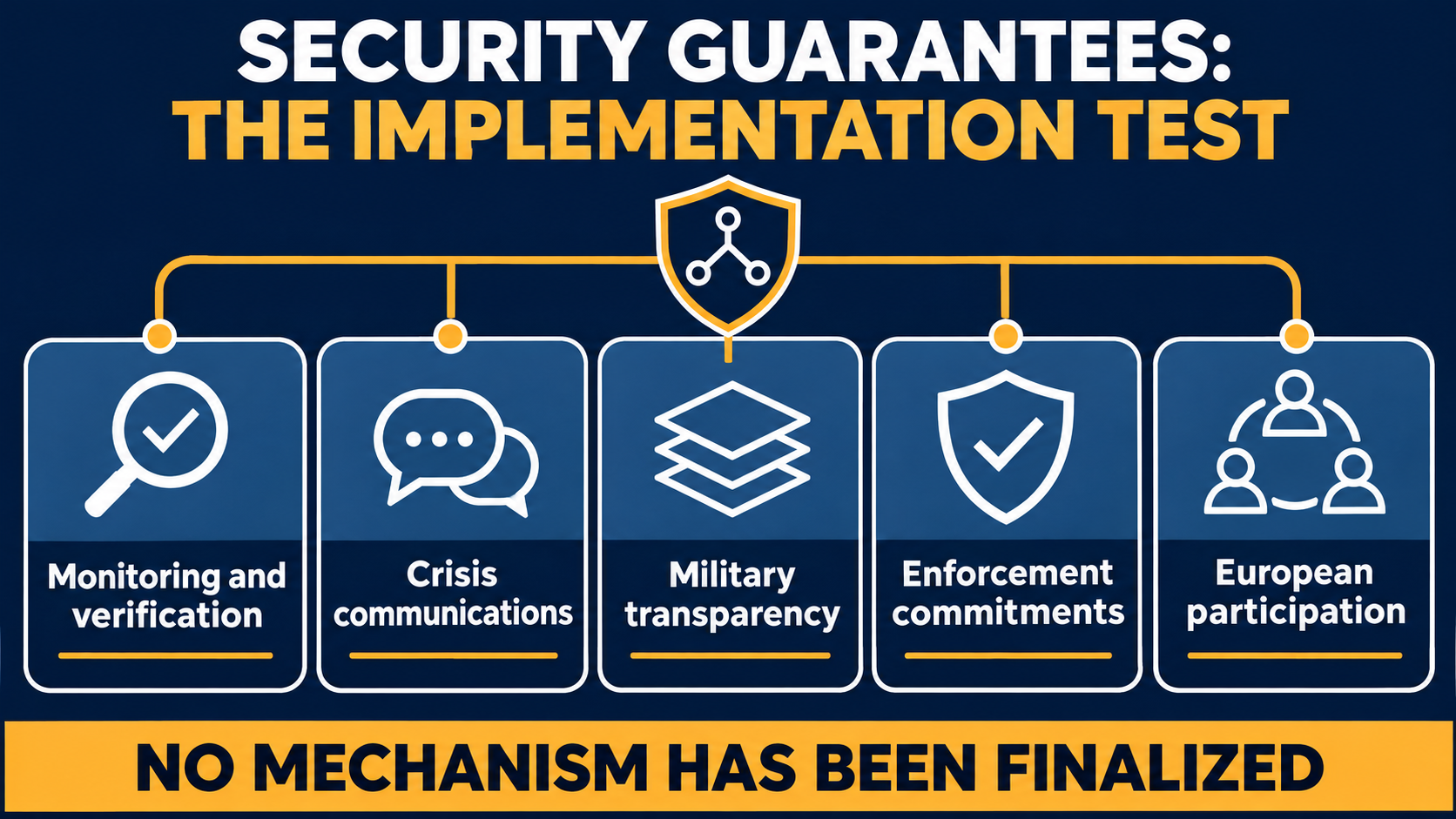
Comparisons to NATO’s Article 5 can clarify the goal but also create confusion. Article 5 applies to NATO members and obliges allies to assist an attacked ally, while allowing each government to determine the action it considers necessary. A Ukraine-specific guarantee would be a separate arrangement. Its credibility would depend on named guarantors, consultation procedures, response timelines, military support and the domestic legal authority to act.
Europe’s participation is therefore not a procedural detail. European states would bear much of the military, economic and humanitarian risk of a failed agreement. Ukraine and Germany say Europe must have a role in decisions affecting the continent’s security. European envoys are expected to hold separate consultations in Abu Dhabi, while the main table remains trilateral. That structure may help coordination, but it also exposes a gap between who negotiates the initial framework and who may be asked to implement it.
Territory presents another implementation problem. A ceasefire line can freeze military control without settling legal sovereignty. If the parties use different language for control, borders and annexation, the ambiguity can become the next crisis. Any workable arrangement would need to distinguish temporary military measures from legal recognition and specify how disputed areas are handled while political talks continue.
Force posture and transparency would also matter. Measures could include notification of major exercises, restrictions on certain deployments near agreed lines, protected monitoring access and rapid military-to-military communication. Such tools cannot substitute for political agreement, but they can reduce the chance that an accident, misread movement or disputed strike collapses a ceasefire.
The Oleshky humanitarian ceasefire offers a small-scale example of coordination around a specific location and purpose. Scaling that model to a long front, major cities and long-range weapons would be far more difficult. The central test is whether the parties can move from a limited exception to rules that apply consistently across the conflict.
Security guarantees are credible only when the response to a breach is understood before the breach occurs. Until negotiators identify monitors, decision-makers, timelines and enforcement mechanisms, the phrase remains an objective rather than an operational system. The Abu Dhabi round can narrow options, but no mechanism has been finalized.

Explore Related Streets
Discover interconnected perspectives across the Knowledge Streets —each Street brings its own lens to the news landscape.

Robot Streets
Robot Streets explores AI systems, humanoid machines, automation breakthroughs, and how robotics is reshaping work, industry, daily life, and the global economy.

AI Streets
AI Streets explores artificial intelligence breakthroughs, everyday tools, emerging risks, practical guides, and how AI reshapes business, creativity, work, and society.

AI Home Street
AI Home Street explores how smart tech transforms everyday living—security, cleaning, cooking, automation, voice assistants, and practical tools that make modern homes easier and more connected.

AIMakeMyDay
Your daily boost of AI-powered ideas—fun prompts, creative tools, and smart shortcuts designed to entertain, inspire, and make everyday life easier.

Nova Streets
Nova Streets explores everyday software from a user’s point of view—productivity tools, creative apps, business platforms, and more. We break things down with clear, hands-on insights, no jargon, and practical guidance that helps beginners and pros make smarter software choices..

AI Business Street
AI Business Street reports on automation, productivity tools, AI startups, enterprise adoption, market disruption, regulations, and how artificial intelligence is reshaping the global economy.
More in News




Explore our other News related sites:
AIMakeMyDay
AI Business Street
AI Education Street
AI Health Street
AI Home Street
AI Streets
Politics Street
Government Streets
Constitution Street
Defense Street
News Street Network